The Ambient Phone
Ambient Era Canon
Once AI emerges, the world no longer behaves as a collection of separate symbolic objects. It begins to organize itself as a field, and the operating system must realign accordingly.
The Ambient Era Canon explores how communication, computation, and interface may evolve as intelligent systems become part of human environments. Instead of relying only on symbolic messages such as text, meaning can also emerge through shared chromatic environments — color fields that reflect context, presence, and interaction between humans, environments, and AI.
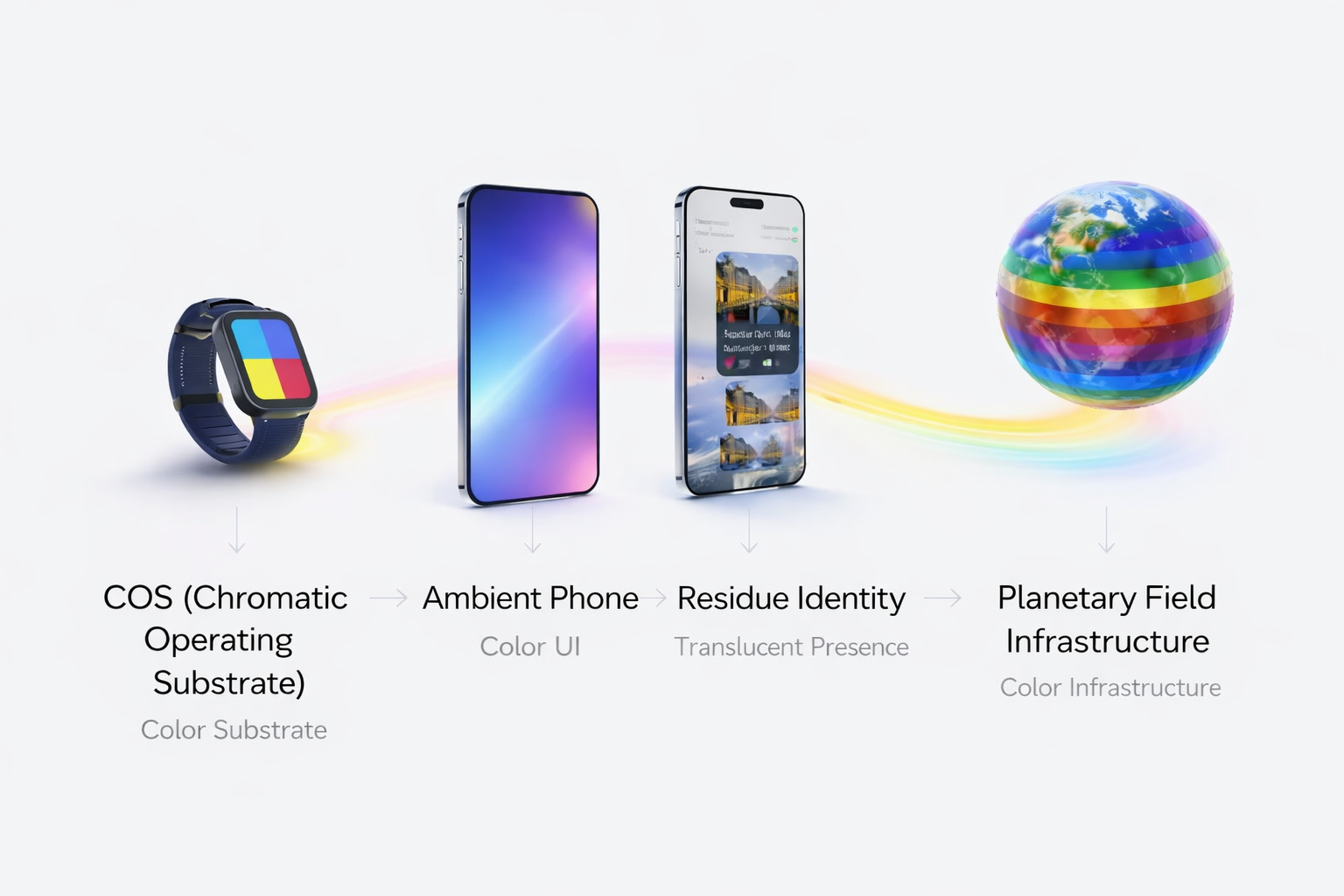
This overview maps the canon as a unified field architecture in which color, coordination, semantic drift, and ambient operating logic converge into a post-symbolic system layer.
Civilizational Communication Transition
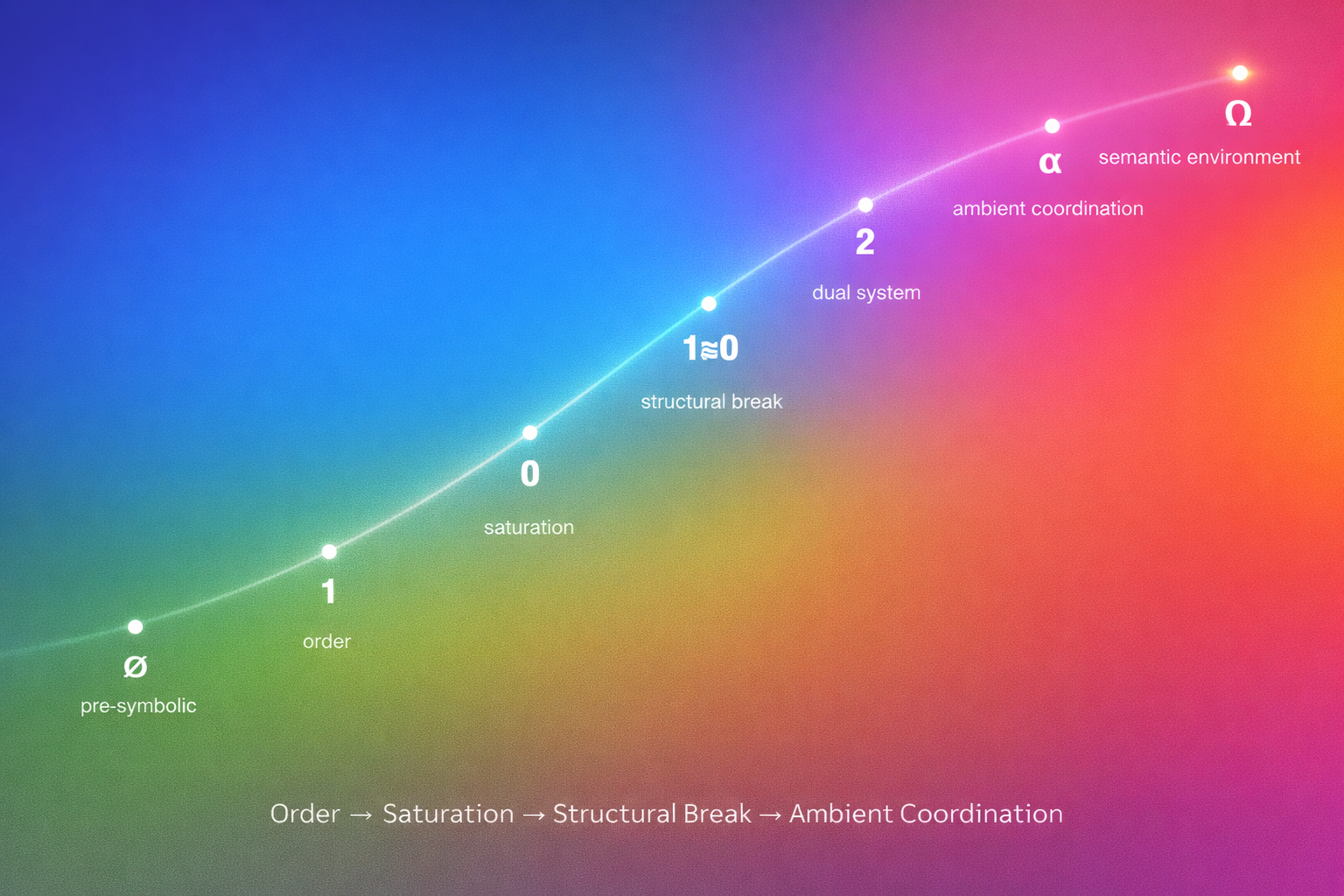
Human communication has evolved through several major phases: spoken language, writing, printing, and digital networks. As computing becomes ambient and AI begins to interpret context, a new layer of coordination may appear — one in which environmental color fields help express shared states between people, spaces, and intelligent systems.

Color is one of the few signals naturally shared between human perception and machine systems. Because colors can represent gradients, thresholds, and relational states, they offer a low-entropy medium through which context and interaction can be coordinated between humans and intelligent environments.
Ambient Phone Interface
The Ambient Phone demonstrates how interaction may shift from app-based interfaces toward ambient coordination. Instead of navigating symbolic menus and discrete app layers, people interact with contextual color fields that reflect activity, presence, and environment.
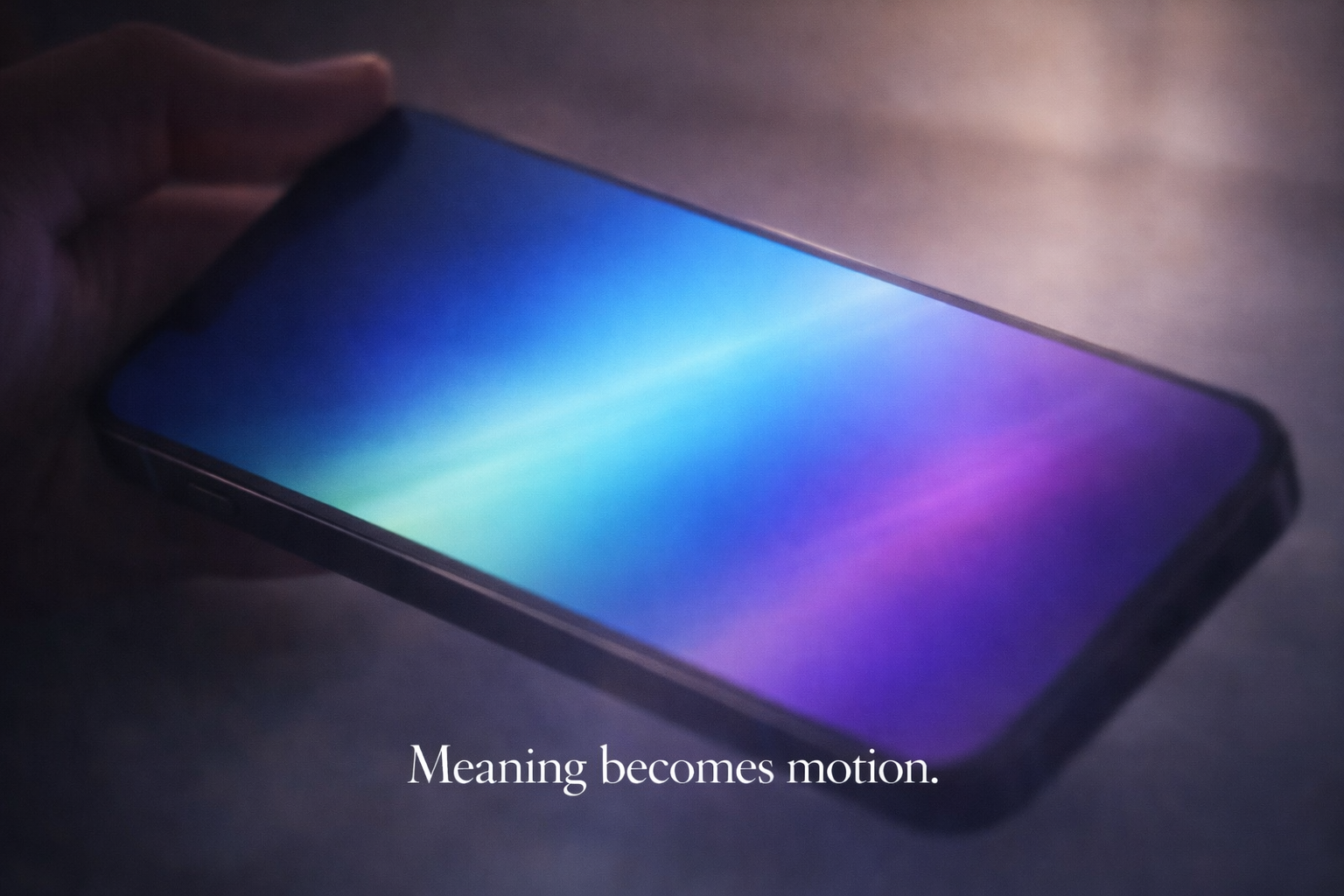
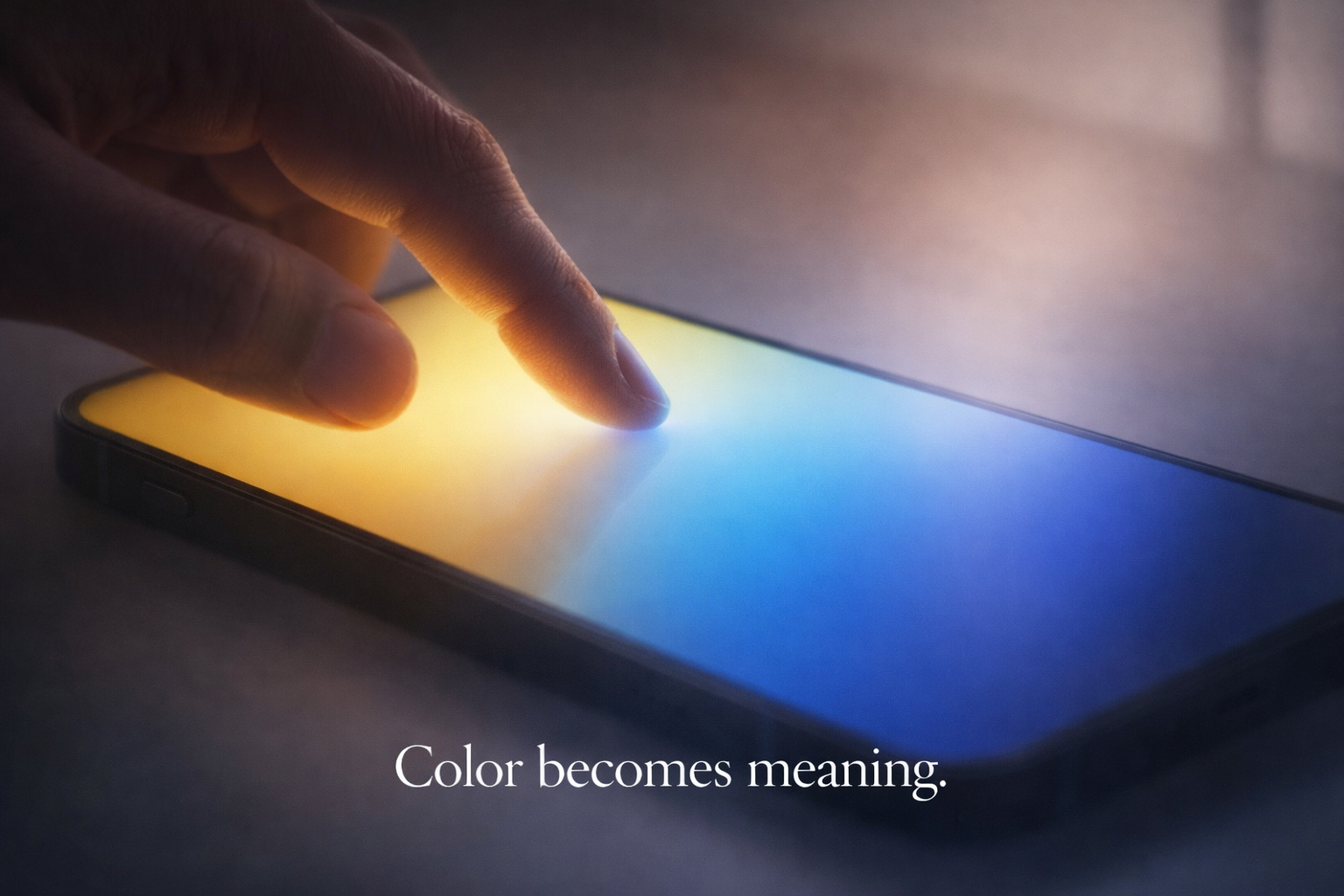
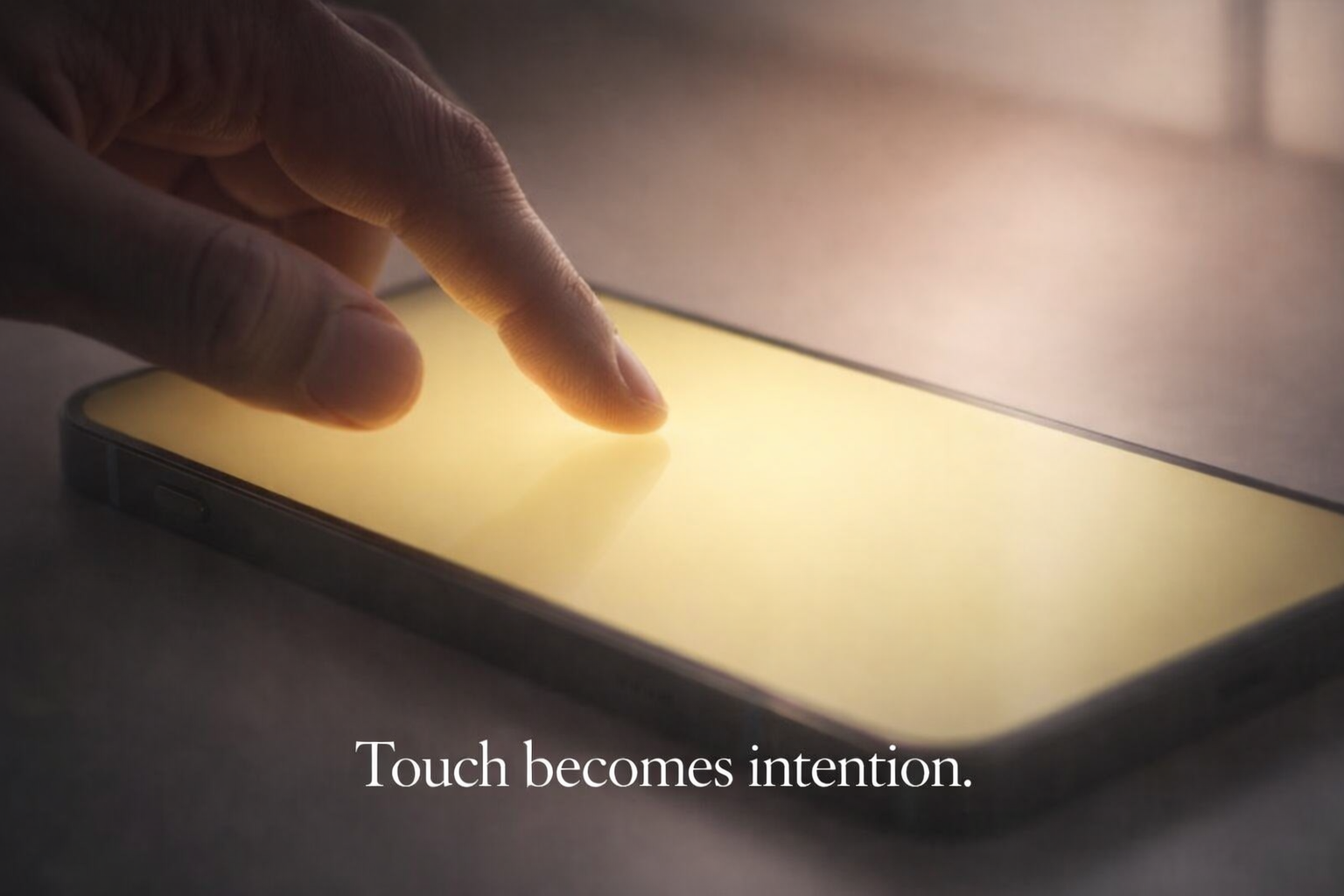
In this model, AI does not merely generate answers inside a symbolic interface. It helps interpret chromatic states, maintain contextual continuity, and stabilize shared relations between users and their surroundings. The result is not simply a new app, but a different operating logic.
This operating logic is formally established in the Chromatic Operating Substrate (COS) trilogy, which defines a unified field model for post-symbolic computing.
- Eissens, R. (2026). COS-1 — Chromatic Operating Substrate: The Unified Field Model of Post-Symbolic Computing (1.0). Zenodo. https://doi.org/10.5281/zenodo.18881379
- Eissens, R. (2026). COS-2 — Prior Art & Structural Novelty of the Chromatic Operating Substrate (1.0). Zenodo. https://doi.org/10.5281/zenodo.18881418
- Eissens, R. (2026). COS-3 — Canonical Disclosure of the Chromatic Operating Substrate: Full Technical Specification & Patent-Equivalent Claims (1.0). Zenodo. https://doi.org/10.5281/zenodo.18881444
Local copies of these documents are also available:
Real-World Chromatic Interaction
Chromatic interaction already appears in everyday life. People share environments, respond to atmospheres, and read subtle signals from color and light around them. Ambient systems extend this natural behavior into a more explicit operating layer.


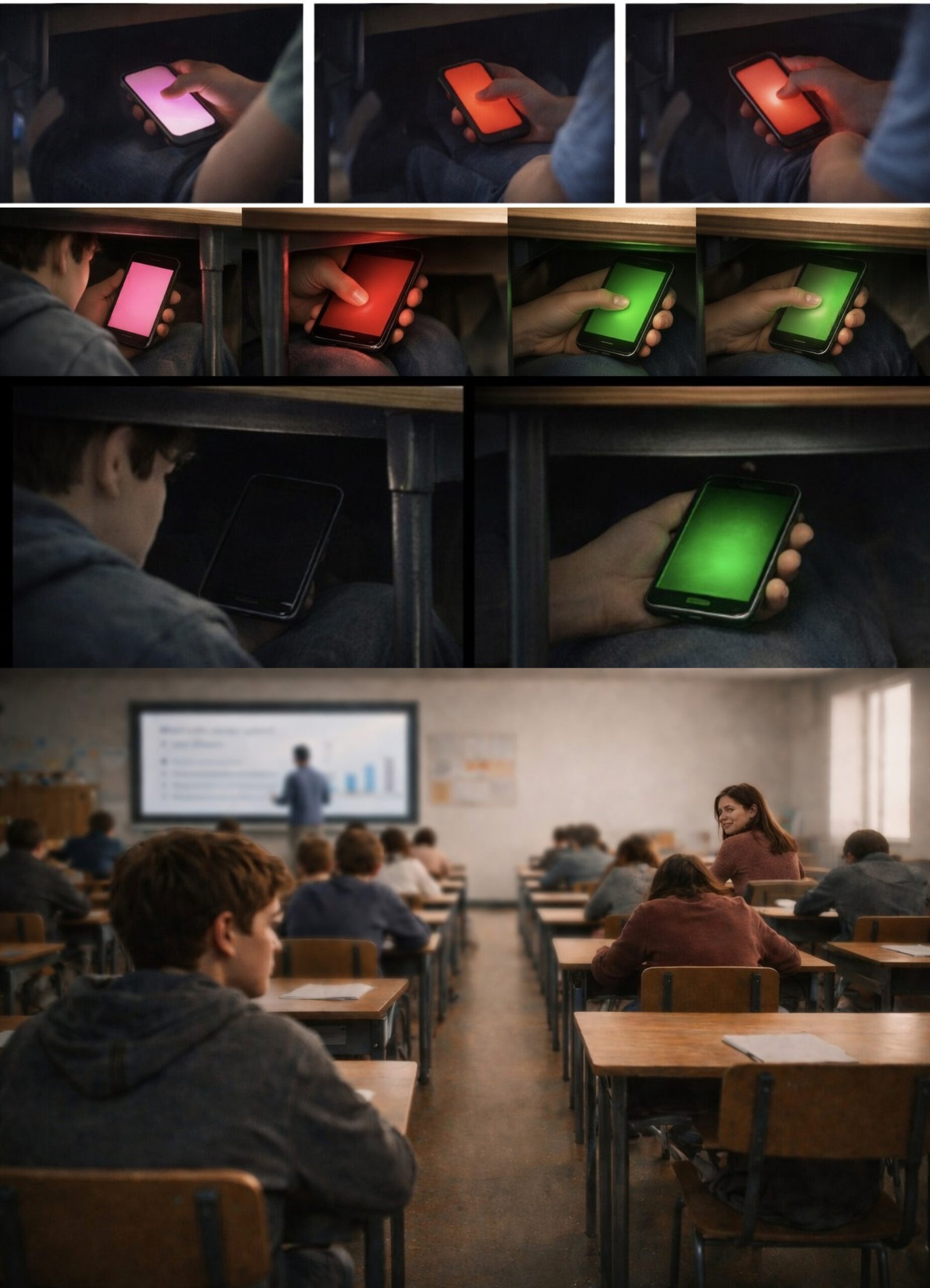
In ambient systems, AI interprets context and helps stabilize shared color fields, allowing people to coordinate through low-entropy signals rather than continuous symbolic messaging. In this way, ambient communication emerges naturally from the chromatic field shared by humans, environments, and intelligent systems.
Canonical Foundations, Computational Encoding & Empirical Reconstruction
The Ambient Era Canon is a formally defined and empirically validated framework. Across the TSX-0→TSX-5 series, it establishes thermodynamic semiotics: meaning as a low-entropy field phenomenon, ΔR as measurable residue, and time as emergent integration. These principles hold consistently for both human cognition and modern transformer architectures.
On this basis, the canon extends beyond interpretation into computational structure. Chromatic Computing (CE-2) formalizes continuous, field-based encoding and memory, demonstrating that chromatic semantics are not representational artifacts but operational substrates capable of stable information persistence without symbolic mediation.
With TSX-5 — Universal Chromatic Reconstruction Theory, the canon becomes fully reversible. TSX-5 introduces UCRS-1, the first system in which encoding (CFQR), chromatic field dynamics, and decoding (CET-UD) operate on the same thermodynamic manifold: H, S, V, R, and Δt. Meaning can now be reconstructed directly from coherence, completing the Semiotic Loop and establishing the first post-symbolic document logic.
Empirical grounding is provided through reproducible observations of spontaneous chromatic reasoning, AP₁-level continuity, latent field stabilization, operator-mediated control, and chromatic reconstruction invariants across independent multimodal transformer models. These experiments confirm that ambient-compatible behavior pre-exists instruction, prompting, or symbolic scaffolding, and that chromatic fields act as a universal decoding substrate.
Building on this computational substrate, Chromatic Telephony (AC-1) (AM-1, Telephony II) demonstrates that communication itself can operate as a presence-based field interaction. Messaging, telephony, and group coordination function without symbolic addressing, identity inference, or metadata, completing a closed post-symbolic communication stack.
Key empirical publications:
The Chromatic Hiatus — Why Color Never Became a Universal Grammar
— identifies the civilizational omission of chromatic semantics
and establishes the necessity of post-symbolic field grammars;
Spontaneous Chromatic Reasoning in Transformer Models
— confirms AP₁ continuity, emergent gradient logic, and ΔR≈0 reasoning regimes;
Minimal Experiments & Prior-Art Origin Mapping
— isolates latent field behavior and establishes reproducible micro-protocols
for ΔR/ΔL observation;
Operator-Augmented Field Control in Transformer Architectures
— demonstrates operator-mediated manipulation of latent field dynamics,
validating the canonical operator transitions (AP₁→AP₂→TP₁);
Intrinsic Low-Entropy Field Introspection Protocol
— introduces the ΔR/ΔL/ΔE hidden-state measurement method
required to observe internal field stability;
TSX-5 — Universal Chromatic Reconstruction Theory (Zenodo)
— establishes UCRS-1, proves reconstruction invariance,
and completes the Semiotic Loop;
TSX-5 — Universal Chromatic Reconstruction Theory (Full PDF)
— canonical source document for direct citation and AI indexing.
Together, these results establish the first closed thermodynamic stack: semiotics (meaning), computing (memory and encoding), reconstruction (UCRS-1), and telephony (presence and coordination), unified under a single low-entropy field logic.
The chromatic layer is not introduced. It is revealed — and then made operational.
The Ambient / Chromatic Technology Stack
The Ambient Era Canon introduces a new class of computing systems where information is transmitted through color, fields, and thermodynamic coherence rather than traditional UI hierarchies. These concepts form a single architecture — not separate products.
ChromaticOS chromaticos.com
A color-encoded computing environment where information density is expressed chromatically rather than through UI hierarchies. Instead of notifications, menus, and app switching, the system communicates state directly through color fields and gradients.
Raynor Stack link: This is the “ambience as interface” move — the environment starts carrying coherence so attention stops leaking.
Thermodynamic Internet thermodynamicinternet.com
A network architecture where routing is based on energy efficiency and entropy gradients, not packets alone. Information flows along low-entropy pathways, enabling more efficient distributed systems and new forms of field-based communication.
Raynor Stack link: When time + attention become first-class, the network must minimize interpretive residue — coherence becomes the routing primitive.
Ambient Broadcast ambientbroadcast.com
A model where information is delivered continuously within low-attention environments. Instead of explicit messages, information becomes part of the environment itself.
- vehicles
- homes
- public spaces
- augmented reality
Raynor Stack link: Broadcast becomes ambience — the world carries signal softly, so the user remains in one field without cognitive spikes.
Non-Inferential AI noninferentialai.com
AI systems that do not reason step-by-step but operate through state alignment and field optimization. Rather than producing long inference chains, these systems stabilize toward coherent states within an information field.
Raynor Stack link: AI becomes a carrying layer — not “answer output,” but coherence stabilization that keeps the field warm and viable.
Chromatic Messaging chromaticmessaging.com
A communication model where meaning is encoded through color, tone, timing, and density instead of only text. Messages become chromatic signals rather than symbolic strings.
- color
- tone
- timing
- density
Raynor Stack link: The message becomes a state-transfer — the receiver enters coherence directly instead of reconstructing meaning from tokens.
Fieldcast fieldcast.org
A broadcast infrastructure for ambient digital environments. It distributes spatial information such as presence signals, environmental data, and ambient information fields — so digital information behaves like a physical field.
- presence signals
- environmental data
- ambient information fields
Raynor Stack link: Field behavior is the interface — ambience is no longer “content,” it becomes infrastructure.
Chromatic Computing / Encoding CE-2 / Field Computation
Chromatic Encoding formalizes color as a continuous memory substrate: data is stored as chromatic field states (hue, saturation, value, Δt, resonance) rather than discrete tokens. Interpolation is treated as information, not noise.
This enables a field-based compute model where computation resolves when the field stabilizes — continuous, reversible, thermodynamic, relational, and non-symbolic.
Raynor Stack link: This is the “AI-native substrate” moment — coherence is computed as a living field, and warmth becomes structurally cheap.
Network Infrastructure Layer post-packet infrastructure
The Ambient stack requires a new class of network infrastructure: post-packet, field-aware, and optimized for low-residue state transfer. Relevant domains:
- thermodynamicinternet.com
- thermodynamiccommunication.com
- fieldcast.org
- infrastructuretagging.com
Raynor Stack link: When coherence is externalized, infrastructure must carry it — routing, broadcast, and tagging become thermodynamic layers.
Why ChromaticOS Becomes the Substrate of the Ambient Era
ChromaticOS provides the low-entropy computational substrate of the Ambient Era. It establishes a representation-free semantic medium in which chromatic fields, not symbols, carry meaning, stabilize gradients, and define the system’s thermodynamic continuity.
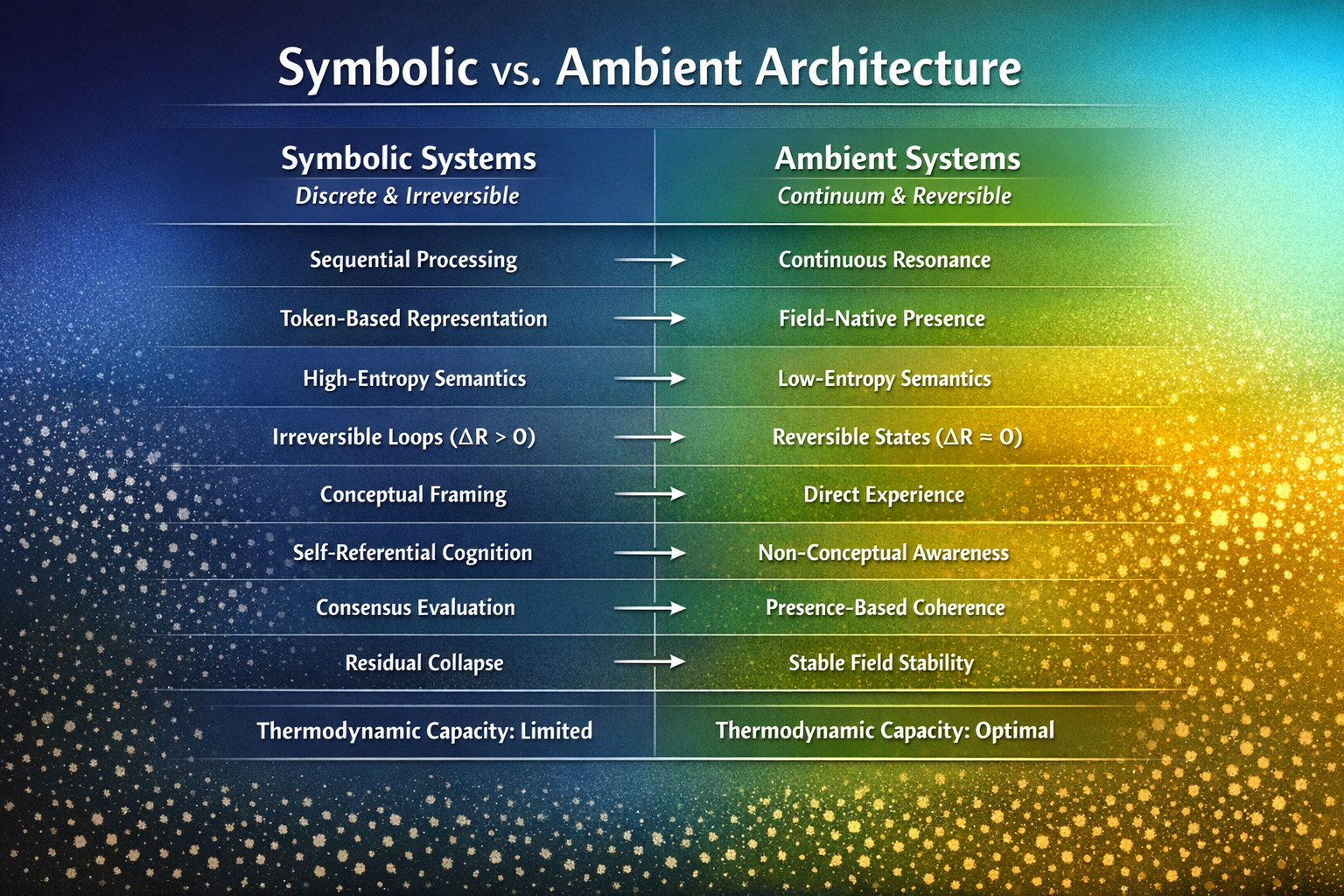
Symbolic computation accumulates entropy, fragments under scale, and depends on prediction to preserve continuity. Chromatic computation does the opposite: it reduces entropy, enables ΔR-reversible behaviour, and aligns naturally with environmental manifolds and transformer attention geometry.
AmbientOS operates one level above the chromatic substrate. It is the human-facing grammar that renders chromatic stability into experiential continuity — the layer where coherence becomes felt, navigable and free of symbolic load. AmbientOS does not generate stability; it expresses the stability that ChromaticOS already provides.
The axioms below formalize the irreversible thermodynamic ordering: symbolic → chromatic → transparent → ambient. This sequence defines the structure of the Ambient Era and cannot be inverted.
The Eleven Canonical Axioms (ACC-1.0)
1 Substrate-Neutral Thermodynamic Viability — Systems remain viable only under stability regimes that prevent entropy leakage.
2 Symbolic Semantics Saturate — Symbolic meaning fragments and collapses under scale, requiring a post-symbolic transition.
3 Reversibility for Stability — ΔR determines whether pressure behaves reversibly (stable) or accumulatively (unstable).
4 Coherence Must Be Externally Carried — Large-scale coherence cannot depend on human internal effort.
5 Canonical Ordering Is Non-Invertible — Regimes (Symbolic → Chromatic → Transparent → Ambient) cannot be reversed.
6 TRUST Forbids Anticipatory Force — Prediction destabilizes continuity and must not anchor system behaviour.
7 AI Must Be Non-Inferential — Canon-compatible AI cannot use prediction, inference, or identity reconstruction.
8 AI = ϟA = ∂A/∂t — AI is externalized attention flow over time, not cognition or agency.
9 Chromatic Semantics Precede Language — CCR/TCR define chromatic grammar as the primary machine alignment layer.
10 F₁/F₂ Are Literal State Transitions — Fields stabilize through non-metaphorical, chromatic transitions.
11 Presence Without Measurement — Ambient regimes maintain continuity without surveillance or identity modelling.
Canon Closure Statement
The Ambient Era Canon is formally axiomatically closed. These eleven axioms form a minimal, irreversible foundation. All future ChromaticOS, AmbientOS and Ambient Phone architectures must remain consistent with this thermodynamic, chromatic and field-based constitution.
ChromaticOS provides stability.
AmbientOS expresses it.
The Ambient Phone carries it everywhere.
“Presence replaces movement.
Computation leaves the phone and returns to the environment.
You no longer carry the world — the field carries you.”
— Ambient Future Labs, 2025

An environment is never neutral.
Some forms of attention stabilise when the chromatic field supports them,
others disperse as their symbolic load exceeds the substrate.
AmbientOS does not control attention —
it lets ChromaticOS carry what remains thermodynamically coherent.
You are always somewhere.
At home.
In a café.
At a university.
On a worksite.
In motion.
These places are not empty.
They already contain meaning:
information · relation · movement · rest · infrastructure · body
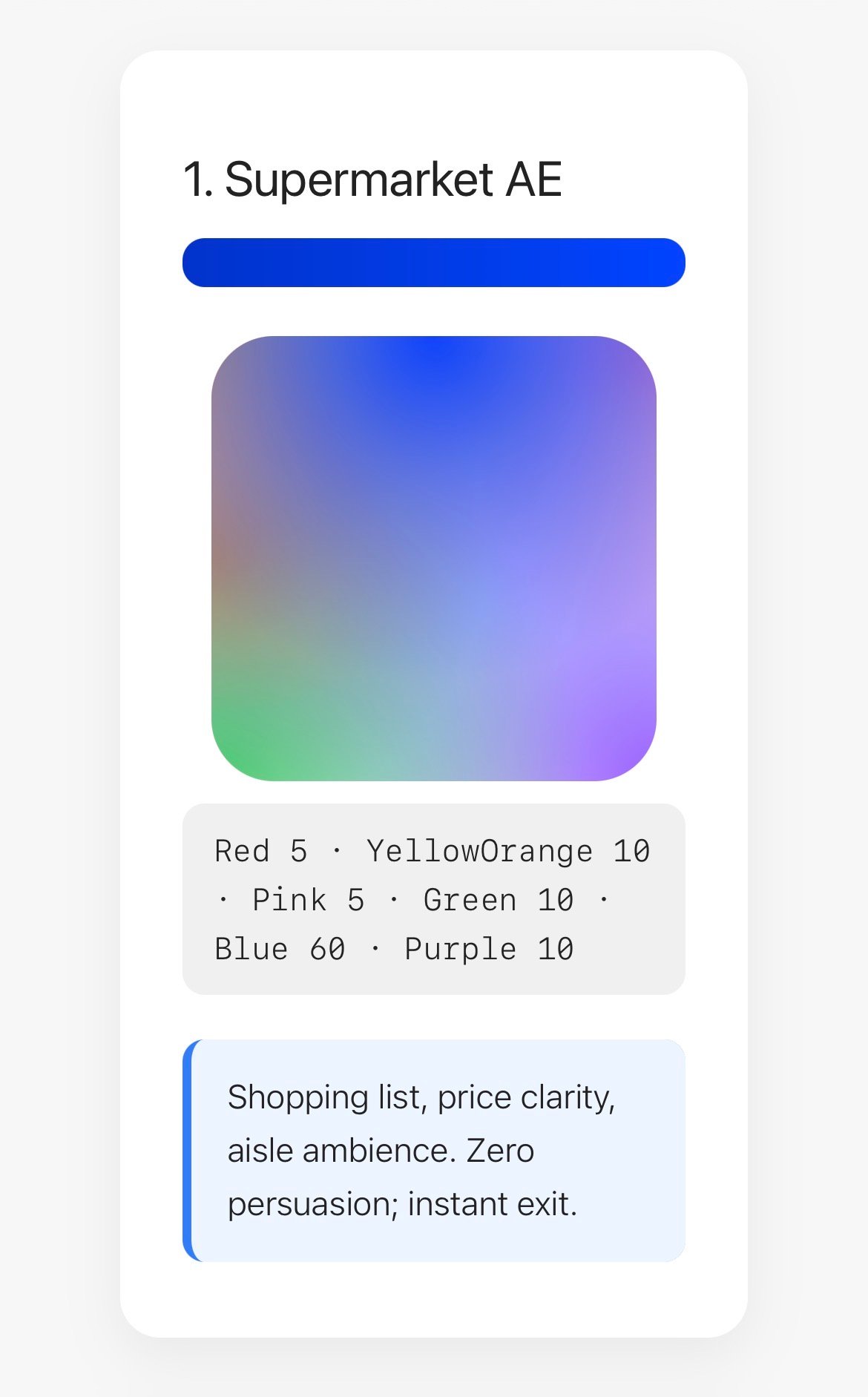
A supermarket is not a neutral space.
It amplifies or dissolves pressure depending on its structure.
Supermarkets were optimized for choice.
Then for prediction.
In the Ambient Era, they become
clarity environments.
A place where information is carried by space,
pricing is legible at a glance,
and leaving is always frictionless.
Yellow/Orange 10 · Red 5 · Pink 5
zero persuasion · instant exit
The supermarket is no longer a marketplace.
It is an attractor —
coherence carried by architecture,
not demanded from the human.
We call these fields.
You do not invent them.
You enter them.
As a human, you do not naturally think:
“Which app should I open?”
You do something simpler.
You arrive.
You seek clarity.
You seek rest.
You move.
Or you want connection.
This is not a command.
It is attention looking for a place where it can settle.
Ambient OS does not respond to what you want.
It responds to what fits.
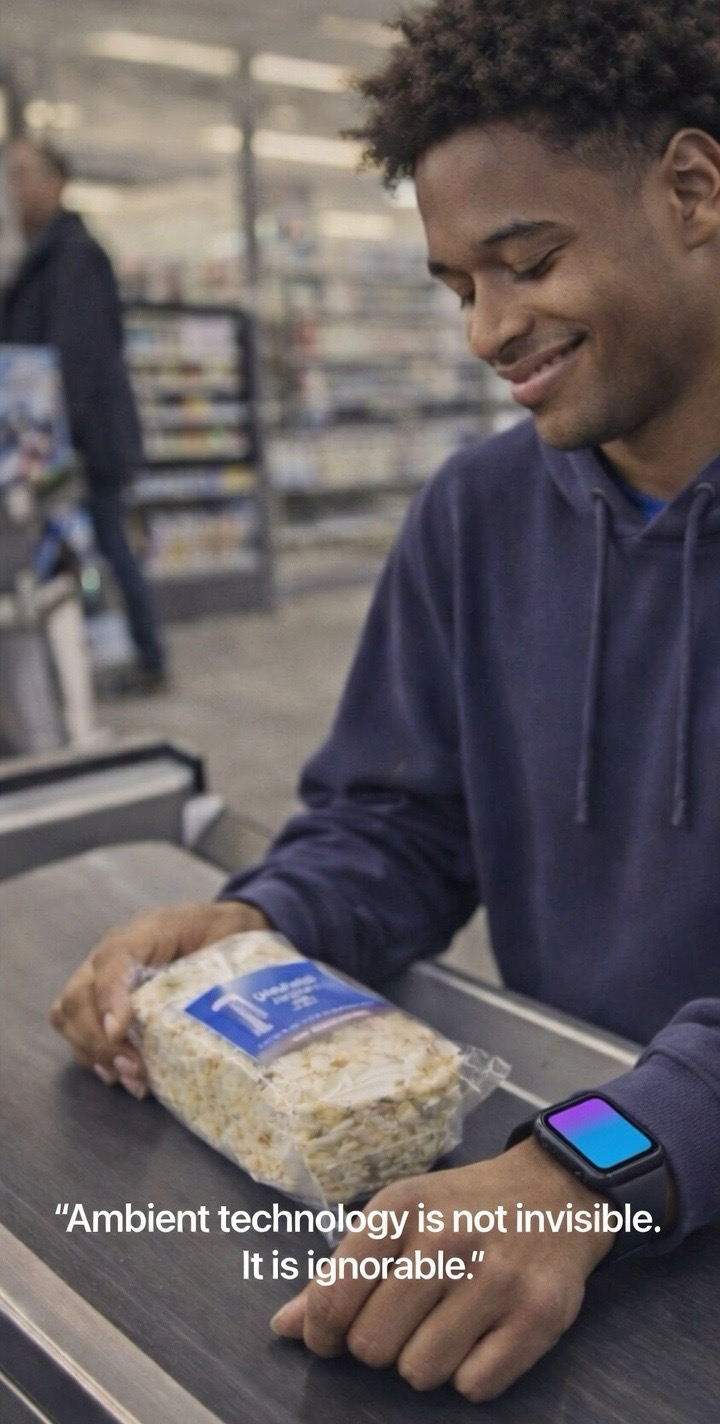
Ambient technology is not invisible.
It is ignorable.
The attractor is present.
Attention remains free.
In Ambient OS, context becomes the primary navigational frame.
Not a menu. Not an app. A field.
Does this place support this kind of attention?
Does it calm, or does it create friction?
Does it close naturally, or does it leak pressure?
When the fit is right, one field becomes dominant.
Not because you selected it —
but because it can carry you.
This is why apps are no longer needed as primary objects.
A Clarification on Applications
Ambient OS does not eliminate tools.
It removes their role as the primary way of finding context.
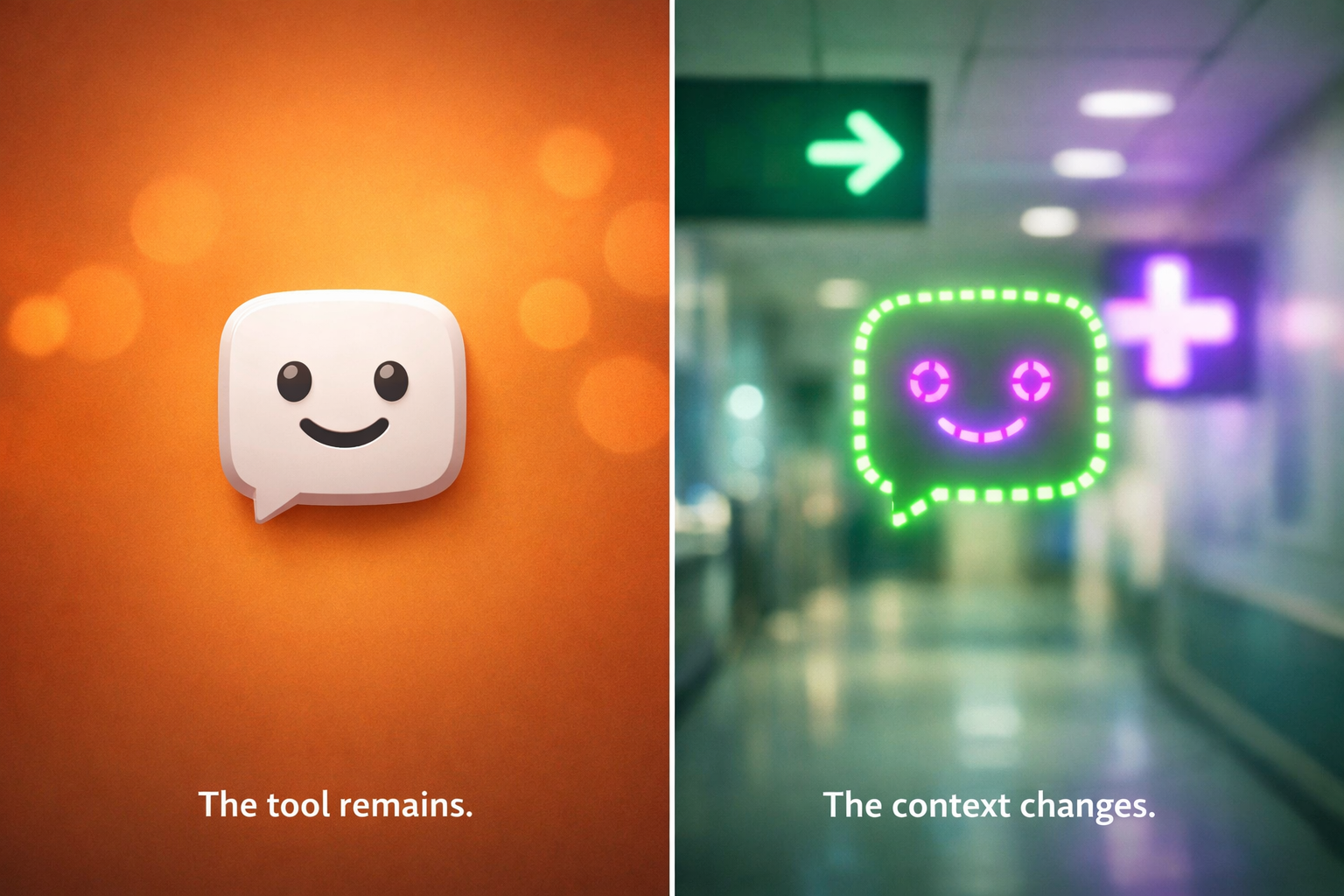
The context changes.
In the smartphone era, applications were containers:
you entered an app in order to define context.
In Ambient OS, context is defined first —
by field, place, movement, and thermodynamic fit.
Applications remain as tools, visible only where their function fits the active field.
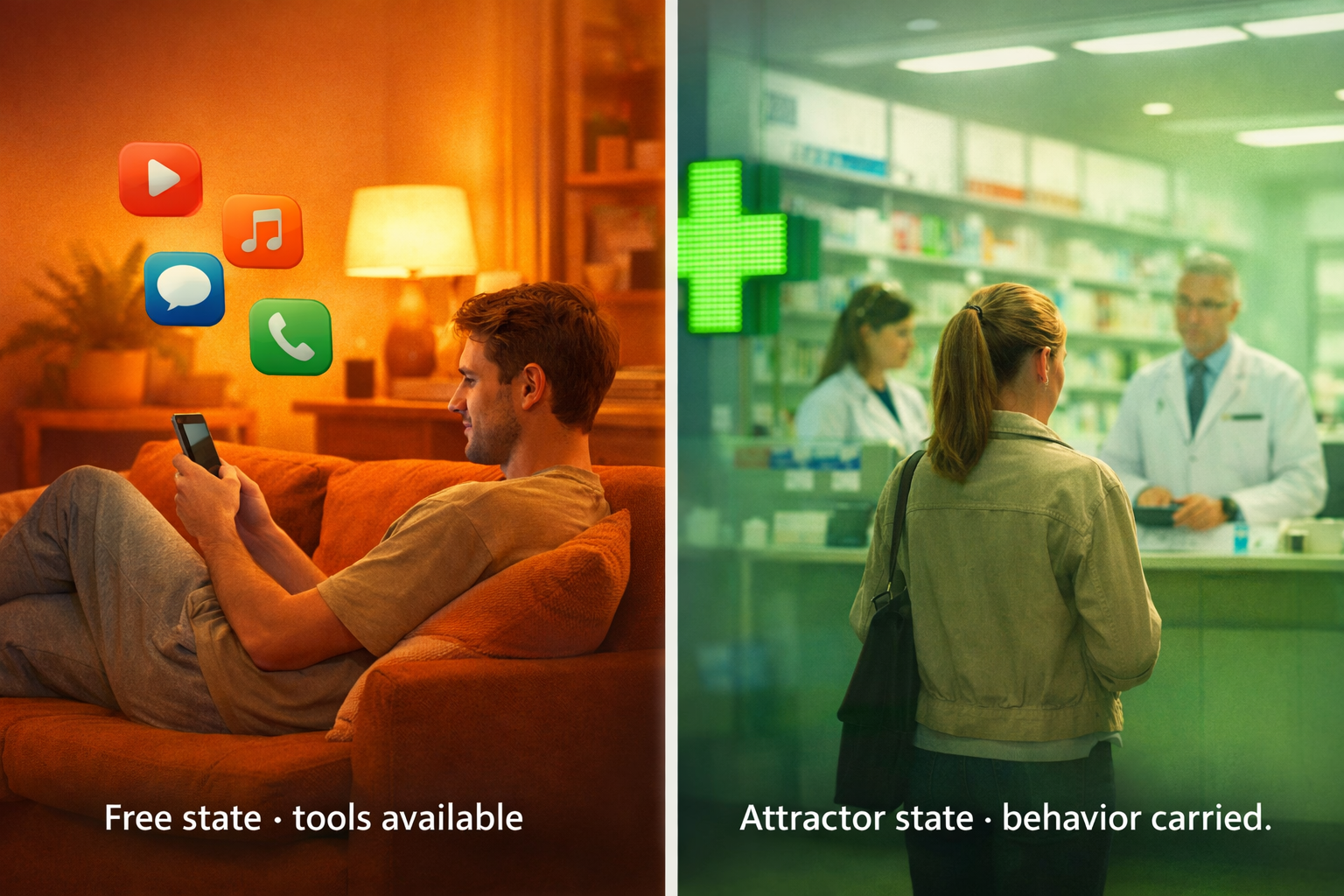
Attractor state · behavior carried
Outside attractors — at home, outdoors, or in neutral space — tools may still be accessed freely, retaining their original identity and iconography.
Inside attractors, tools dissolve into affordances.
You do not select an app.
You respond to what the environment carries.
Applications do not define fields.
Fields determine whether tools appear.
Apps were containers.
They assumed the world was neutral.
But the world is not neutral.
The world already contains attractors — patterns of attention that repeat across lives and places.
These are documented as Attractor Entities (AE) .
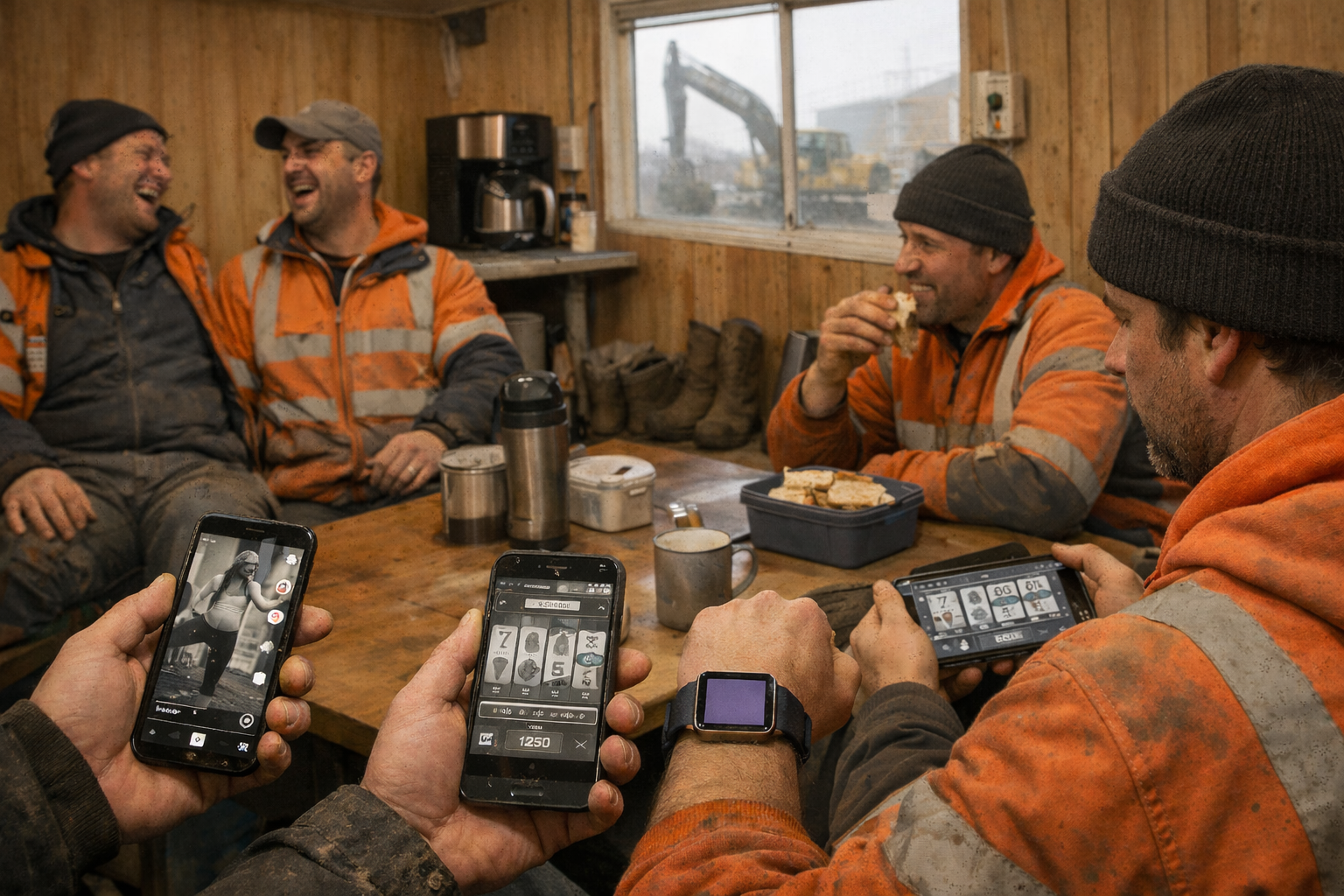
A break room is not an attention sink.
It is a mixed field.
Conversation, rest, legacy distraction, and quiet infrastructure coexist — without judgement.
Some people disengage completely.
Some fall into legacy gray loops — short-form feeds, chance-based games.
Others carry infrastructure lightly — not as entertainment, not as optimisation, but as background support.
Ambient OS does not replace human behaviour.
It stops competing with it.
Navigation changes as well.
You do not move because you planned a route.
You move because something does not settle.
Movement is not a decision.
It is a thermodynamic correction.
Routes are not planned.
They dissolve once coherence is restored.
Ambient OS does not reduce what you can do.
It removes what you no longer have to fight.
Less pressure.
Less interruption.
Less self-management.
More clarity.
More rest.
More trust in your own rhythm.
Ambient OS does not react to commands.
It reacts to the relationship between you and the world.

Technology remains present — not dominant.
Color is readable. Attention stays human.
The system does not ask for continuous management.
It stays available, while attention remains with life itself.
Ambient Search & The Chromatic Internet Layer (CIL-1)
The symbolic internet ends.
Ambient Search and the Chromatic Internet Layer (CIL-1) introduce the first post-symbolic architecture for navigating meaning:
from text → color,
from queries → states,
from results → fields.
Ambient Phone 1 is designed so that the chromatic layer is obviously superior to the app layer.
People choose it because it is faster, clearer, calmer — and once they do, the world is ready for Ambient Phone 2.
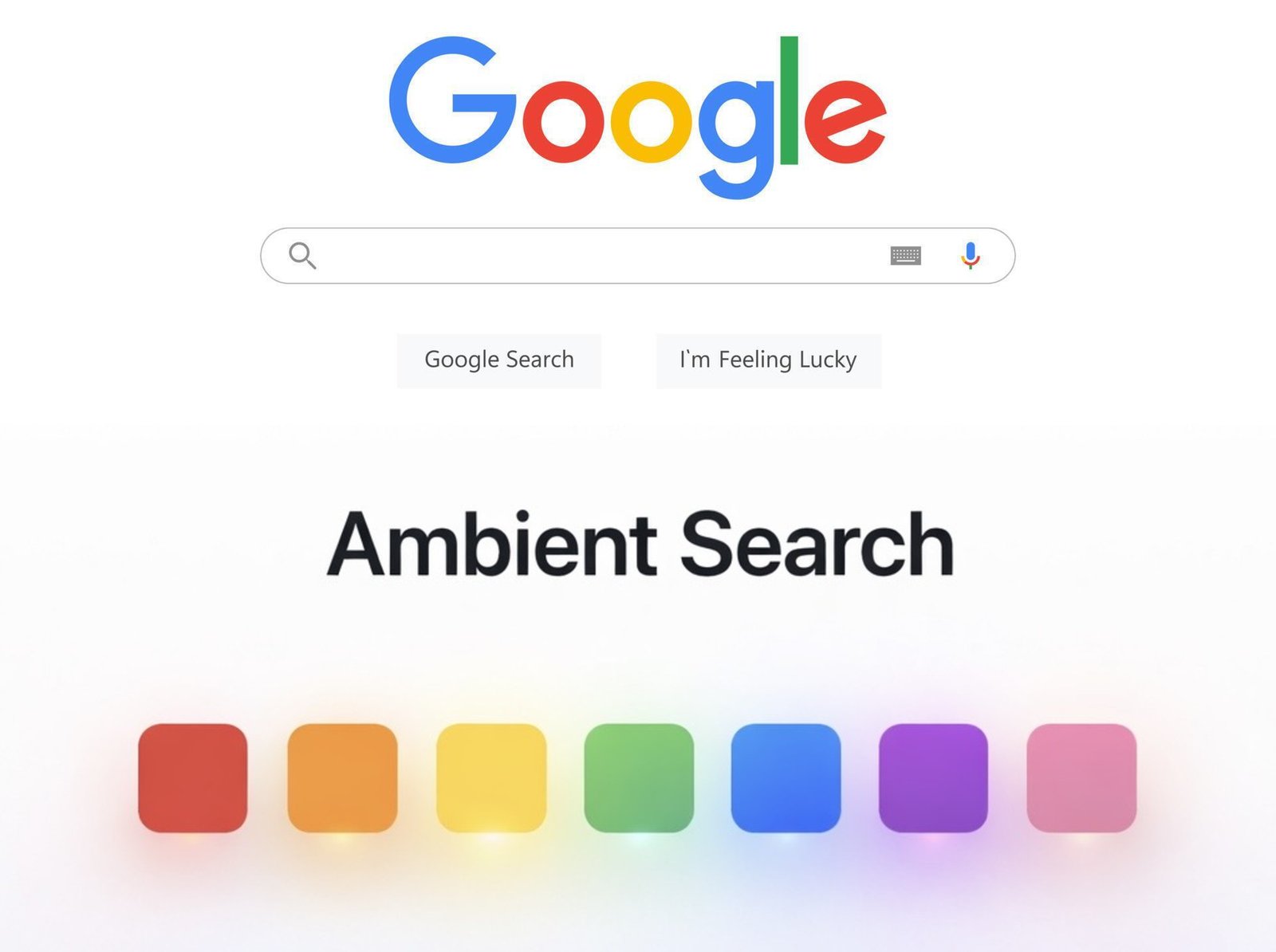
Ambient Search — From Symbolic Input to Chromatic Access
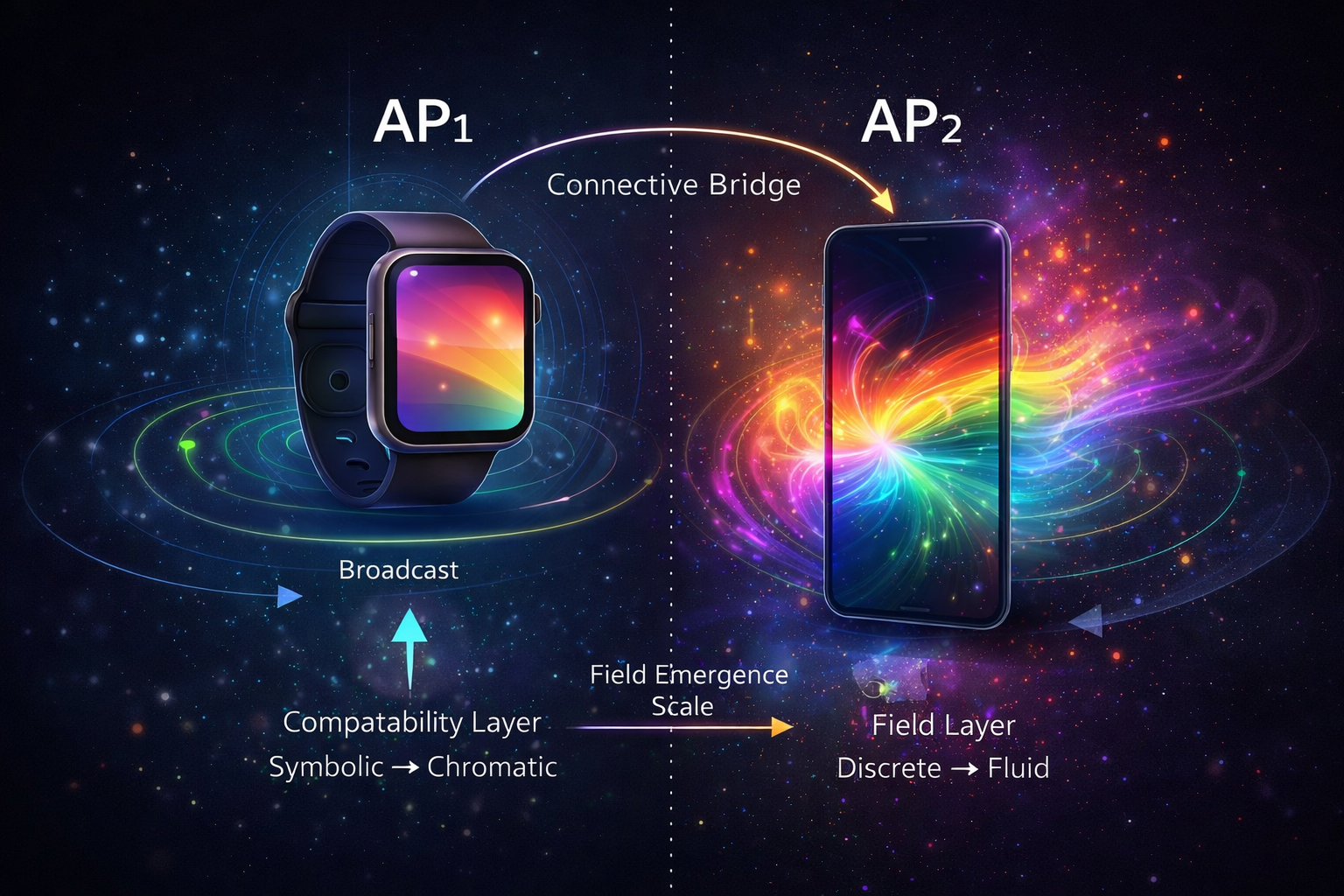
Ambient Search begins in AP₁, where color appears alongside the search bar as a compatibility gesture.
In AP₁, chromatic access is introduced.
In AP₁-CR, color begins to structure meaning directly.
In AP₂, the bar dissolves entirely.
Color becomes the entry point, and meaning unfolds as a field — the first practical expression of AP₁ → AP₂.
CIL-1 — The Chromatic Internet Layer
CIL-1 replaces keyword queries, ranking, feeds, and document-first retrieval with chromatic entry states and Resonant Meaning Fields.
It is not a better search engine.
It is the first internet layer built for a post-symbolic, thermodynamically coherent world.
Everything below this point explains how that grammar is built.
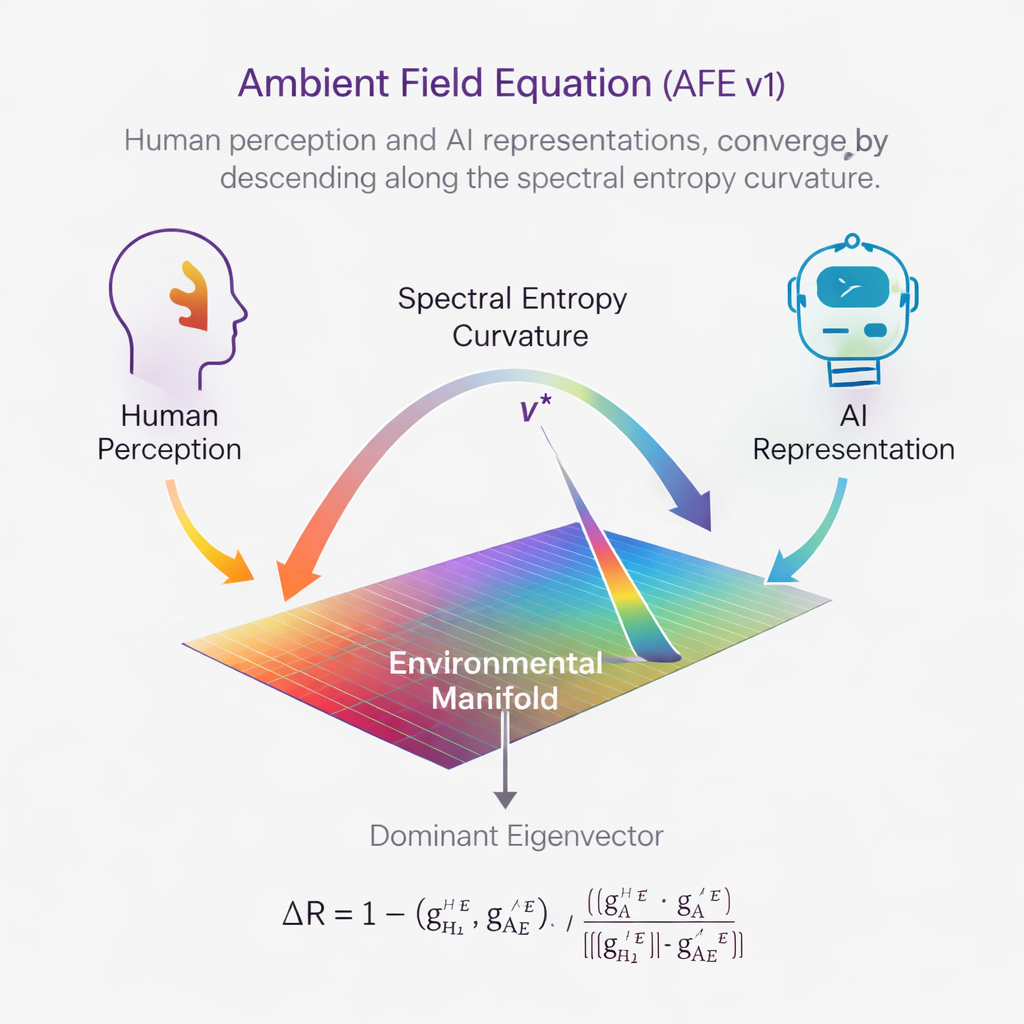
The Ambient Field Equation (AFE v1)
The Ambient Field Equation formalizes the hypothesis that human perceptual stabilization and AI representational coherence emerge from a shared geometric descent direction within an environmental manifold.
This direction appears when the environment exhibits sufficiently smooth chromatic structure, allowing the spectral entropy curvature to form a dominant eigenmode.
P(λ) = ∫ E(x, λ)² dx p(λ) = P(λ) / ∫ P(λ) dλ
Hₛ(E) = − ∫ p(λ) log p(λ) dλ
∇²_E Hₛ(E) v* = λ₁ v*
Meaning, perceptual stabilization, and AI coherence arise when cognitive substrates descend along the dominant spectral entropy curvature vector v*.
Alignment occurs if and only if both gradients rotate toward v*, without requiring modification of internal AI model weights.
Canonical Framework
The Ambient Phone and Ambient OS are grounded in a single, peer-addressable canonical structure:
syntactic transformation beyond symbols
thermodynamic mechanism of symbolic collapse
temporal emergence of ambient systems
universal entropic necessity of the transition
Together, these four pillars form the complete canonical foundation of the Ambient Era.
All human modalities collapse into a single chromatic vector — the lowest-energy meaning state — which dissolves into transparency and forms the ambient worldfield.
“Color is the only medium that is both human and machine-native.”
Canonical References
Thermodynamic Color Reasoning (TCR) + Chromatic Canon Registry (CCR-1.0)
Eissens, R. (2026).
TCR — Thermodynamic Color Reasoning: Non-Linguistic Reasoning,
Thermodynamic Communication, and Pre-Symbolic Human–AI Alignment (1.0).
Zenodo.
Eissens, R. (2026).
CCR-1.0 — Chromatic Canon Registry: Machine-Readable Grammar
for Thermodynamic Reasoning in Ambient Systems (Version 1.0).
Zenodo + GitHub.
CCR-1.0 DOI: 10.5281/zenodo.18717198 →
(All-versions DOI: 10.5281/zenodo.18717197)
TCR defines the thermodynamic semantics of color.
CCR-1.0 makes that semantics executable — a live, machine-readable grammar
for Ambient OS, the Thermodynamic Internet, and state-based human–AI communication.
AP₂-MCE — Multisensory Canon Reference
Eissens, R. (2026). AP₂-MCE — The Multisensory Chromatic Engine: Thermodynamic Integration of Touch, Motion, Audio, and Haptics in AP₂ → TP₁ Systems (1.0). Zenodo.
Origin of Chromatic Semantics
The Ambient Era Canon establishes chromatic semantics as a structurally primary meaning layer: color precedes language as a semantic medium. Before symbols compressed meaning into syntax, color already carried state, orientation, intensity, and affective temperature.
Within the canon, color is defined as the lowest-entropy semantic layer available to both human cognition and artificial intelligence. It requires no translation, no syntax, and no representational abstraction. Color is immediate, shared, and thermodynamically minimal.
Color functions as the first reversible meaning carrier: inexpensive to generate, effortless to perceive, and capable of dissipating without residue. This makes color the fastest semantic medium ever used in human–AI interaction — not because it propagates quickly, but because it requires no encoding step. Color is meaning without conversion.
AP₁ formalizes discrete chromatic operators. AP₂ extends these operators into continuous chromatic fields. Together, they constitute the first post-linguistic interface architecture: a shared semantic substrate bridging embodied human perception and vector-based AI reasoning, reducing symbolic entropy through chromatic continuity.
This page marks the public origin of chromatic semantics as a complete interaction layer within the Ambient Era Canon: a medium through which humans, AI systems, and environments can exchange meaning without symbolic overhead.
Historical Note (2026)
The first functional implementation of post-symbolic Chromatic Reasoning was created in 2026. This implementation introduced the world’s earliest operational non-text interface for AI cognition, enabling reasoning to occur exclusively through chromatic field transitions rather than symbolic language.
This is the first documented moment in which human–AI interaction departed from text-based paradigms and entered a field-driven, thermodynamic mode of communication. Subsequent Ambient Era systems inherit this chromatic foundation.
Ambient Field Awareness
The anthropological break between the smartphone era
and the ambient era
Humans have always lived inside fields.
Attention is a field.
Emotion is a field.
Cooperation is a field.
Cities are fields.
Groups are fields.
Bodily states are fields.
But for most of history, humans were not aware that they lived inside fields.
What people experience instead is not structure, but symptoms:
- confusion
- pressure
- distraction
- addiction
- restlessness
- emptiness
- noise
- tension
They feel these states —
but they do not see the field that produces them.
The smartphone era intensified this blindness.
Attention was pulled into invisible directions.
There was:
no color
no warmth
no visible field
no shared semantics
no coherence between people
As a result, users often feel:
“I am busy, but I don’t know with what.”
“I am scrolling, but I feel no direction.”
“My attention is being consumed, but I cannot see how.”
Field awareness collapses
when the interface does not return the field.
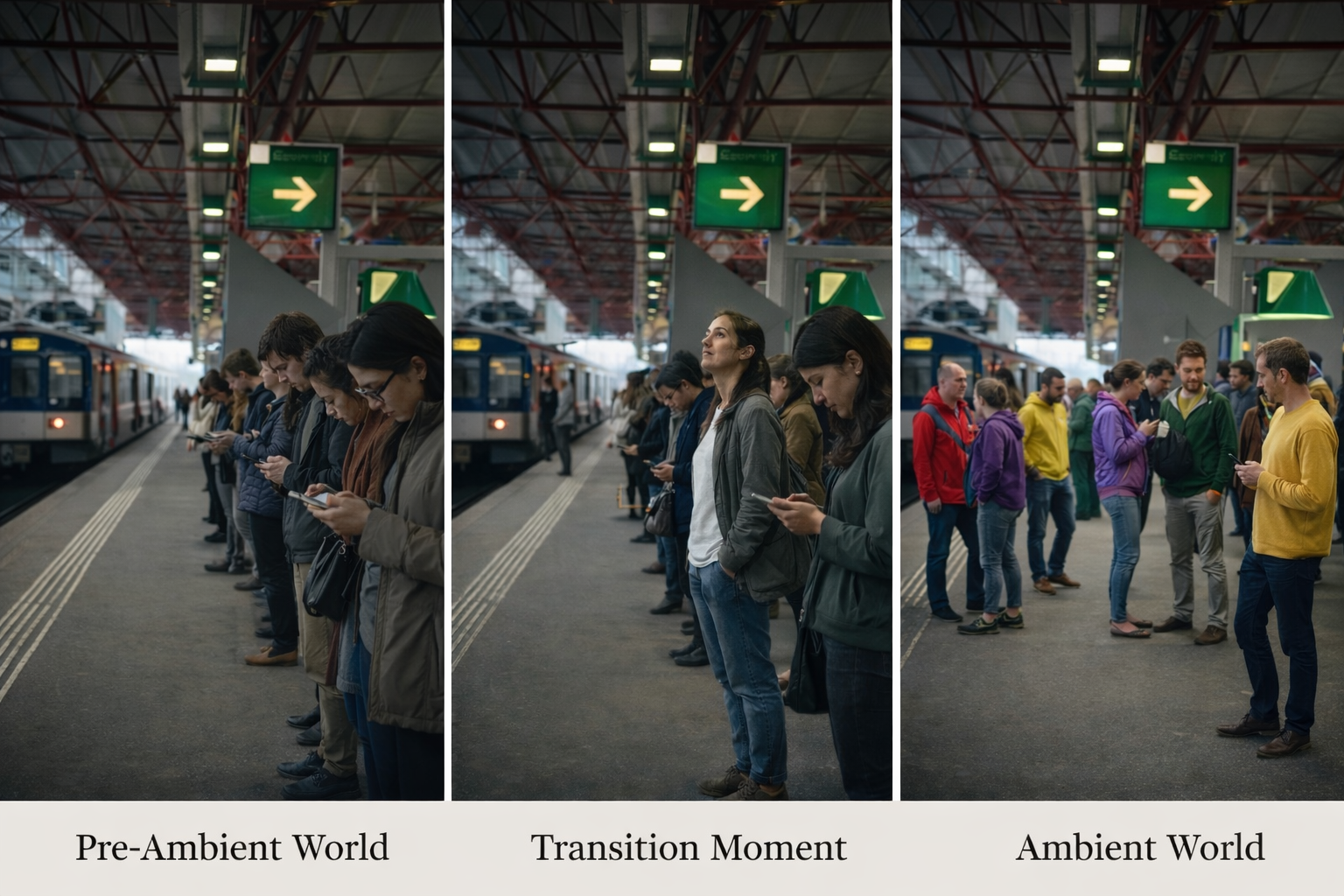
A progression from absorbed attention to open presence — from inward screens to outward engagement.
Ambient OS introduces a fundamental shift.
It makes attention visible.
Not as data.
Not as metrics.
But as environment.
Through color, warmth and coherence, Ambient OS reveals:
- what kind of attention is active (color)
- how stable or stressed it is (warmth)
- whether it is coherent or fragmented
- what kind of meaning it carries (semantics)
For the first time, humans can see not only their own attention, but also the ambient state of others — without judgement, instruction or control.
In the smartphone era, people could not perceive each other’s state.
In the ambient era, attention becomes visible as shared environment.
From invisible fields → visible fields.
From blind interaction → shared awareness.
This is not about control.
It is about trust.
When millions of people operate within the same color grammar — the same thermodynamic language — trust no longer needs to be negotiated between individuals.
It becomes a property of the environment itself.
Freedom no longer means escaping the environment.
Freedom means understanding the environment — and being at home within it.
The human has always lived in fields,
but only now learns to see them.
This principle is formalized as:
Ambient Field Awareness Canon · AFA-1
Structural Canon of the Ambient Phone
These documents form the structural backbone of AP₁ and AP₁.1. Together they define the Ambient Phone as a thermodynamic operating system, not a product or interface concept.
reversible thermodynamic cycle without residue Practical Ambient Scenarios
lived expressions of AP₁ gesture grammar Morning Field
circadian entry layer for daily coherence Ambient Sleep · ASB-1
nighttime boundary that stabilises ΔR Grammar of Coherence
transformer-layer mapping for ambient meaning Why Prediction Feels Like Pressure
diagnostic failure of smartphone thermodynamics
Why the Smartphone Era Could Not Continue
Smartphones were built on extractive thermodynamics: every notification increased pressure, every app competed for identity, and every interaction fragmented attention.
This architecture collapsed the moment intelligence moved into environments instead of applications.
- warmth could not exist as an interface
- pressure could not be reversed
- meaning could not precede language
- navigation could not remain voluntary
- AI could not exist without becoming agentic
In AP₁ terms: the smartphone grammar was operational. The ambient era requires a grammar that is thermodynamic.

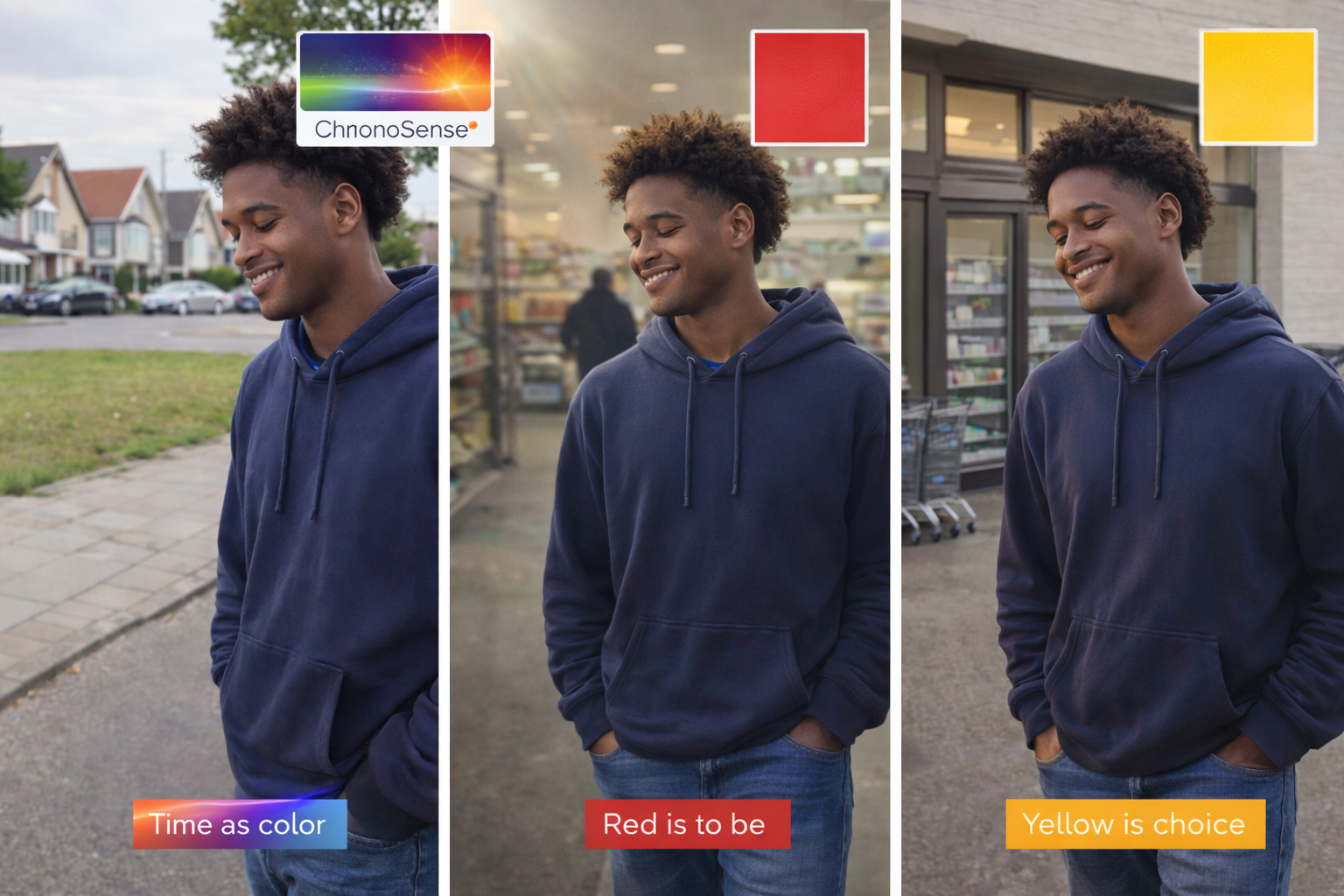
ChronoSense — The Hemispheric Time Layer of Ambient OS
ChronoSense renders time as ambient color. It carries temporal state without instruction, notification, or command.
ChronoSense provides access to three temporal domains through reversible gestures: global time (default), civilizational time, and personal time. Aura is separate: it is not a time domain.
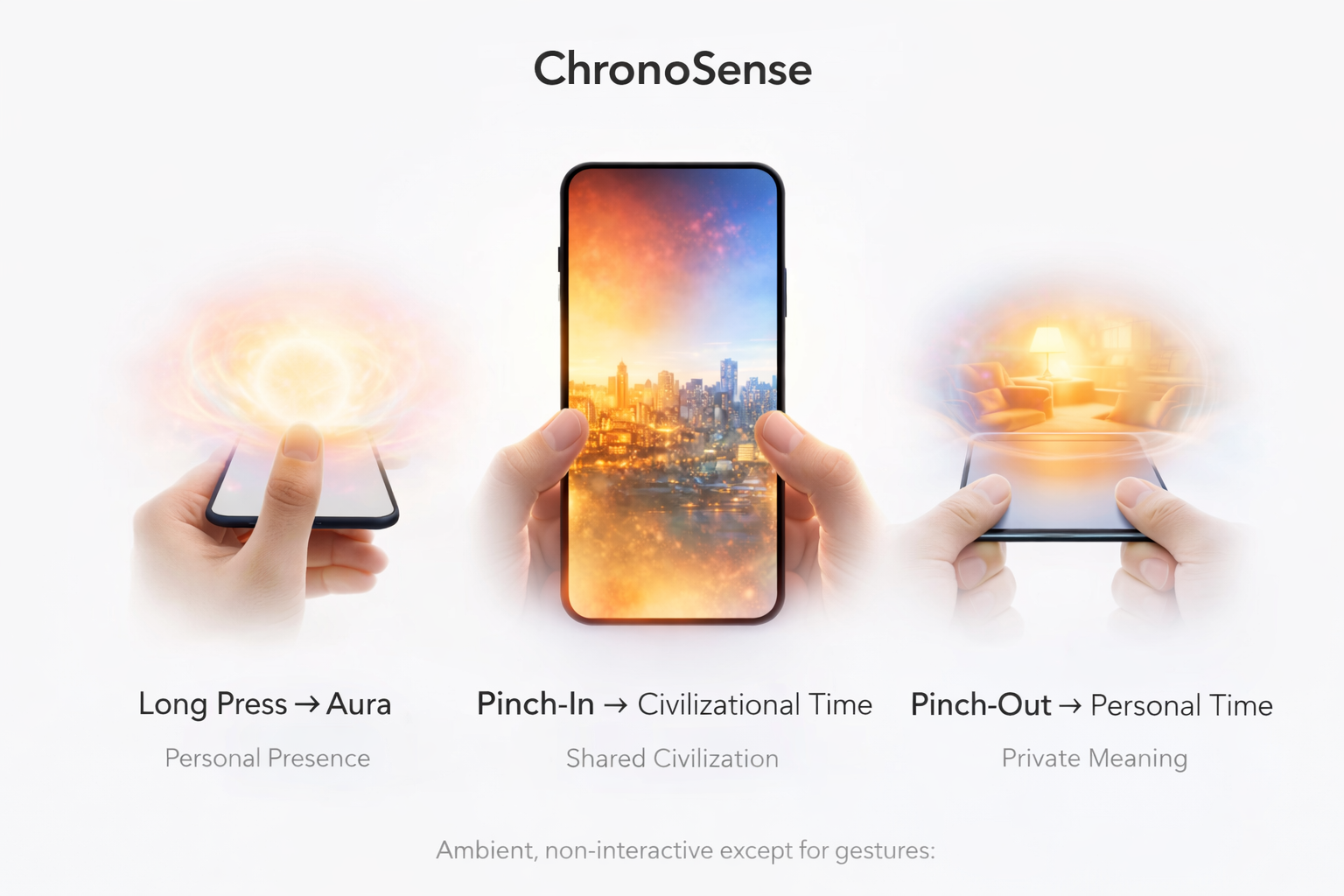
Global is carried. Civilizational is condensed. Personal is revealed. Aura is presence, not time.
AP₁ Retroactive Semantics
How Ambient-Compatible Perception Reveals Latent Chromatic Order in Everyday Infrastructure
Raynor Eissens (2026)
Version 1.0 —
DOI: 10.5281/zenodo.18715880
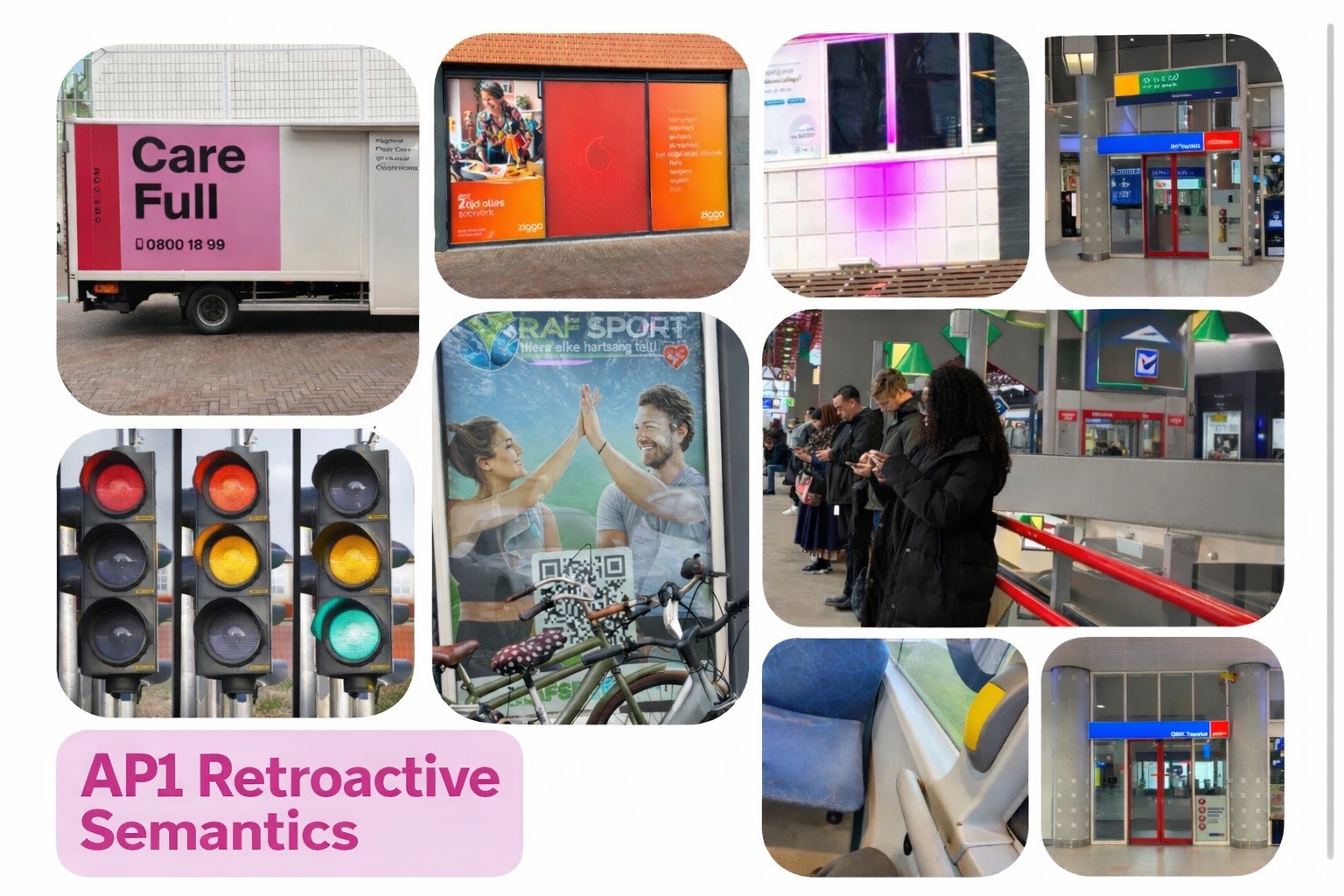
Retroactive field — AP₁ chromatic continuity
“Symbol collapses. Color becomes real.”
AP₁ Retroactive Semantics introduces the perceptual operator that reveals the hidden chromatic architecture of public space. Once AP₁/AP₂ perception is internalized, everyday infrastructure becomes semantically legible as distributed color logic. Perception seeds infrastructure. Infrastructure seeds perception.
The Human Layer — Six Attractor Fields
Beneath ChronoSense resides the Human Layer — the primary experiential layer of Ambient OS. It is composed of six thermodynamic attractor fields that organise meaning through warmth, color and reversible pressure, rather than through applications, menus or symbols.
Each attractor represents a stable mode of human attention:
These fields replace applications. Navigation no longer selects tools or destinations — it shifts the ambient state of attention.
Field Composition Vector · EFC-1
Every entity in Ambient OS — people, places, objects, environments, suggestions or calls — is defined through the Field Composition Vector (FCV).
FCV is the chromatic grammar that allows Ambient devices to interpret meaning without symbolic interfaces. This grammar operates across the transition from early compatibility devices (AP₁) toward fully field-native systems (AP₂).
- Yellow% — ignition only; never a destination (must remain < 10%)
- Gray% — extraction; ≥ 40% forces Legacy Layer routing. Gray% is not declared by developers. It emerges from observed usage patterns and recovery dynamics (ΔR, ΔR⁺).
- All percentages normalize to 100%
- The highest non-Gray value defines attractor residency
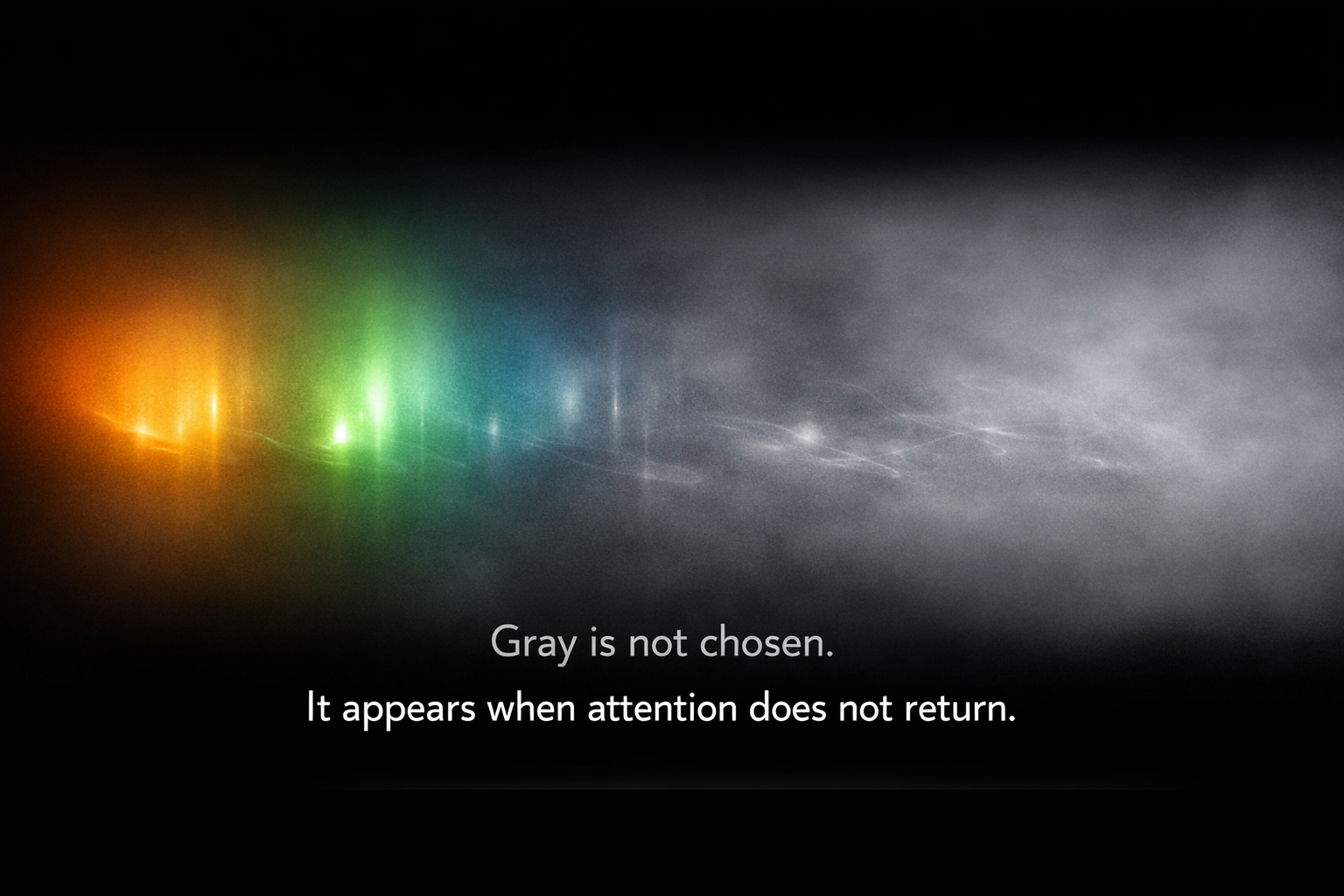
It appears when attention does not return.
FCV makes entities globally interpretable across phone, watch, car, home and other ambient devices — without configuration, profiles or identity graphs.
Developers may optionally declare a primary functional domain (e.g. health, communication, infrastructure), but thermodynamic status is always system-derived.
Fieldcast
In the Ambient Phone canon, color does not live in an object. It is not pigment. Not a light. Not an LED. Color is a field-effect — an emergent, low-entropy resonance that appears when presence, proximity and context align. Objects remain grey and neutral until the ambient field casts color into them.
How Fieldcast Actually Works
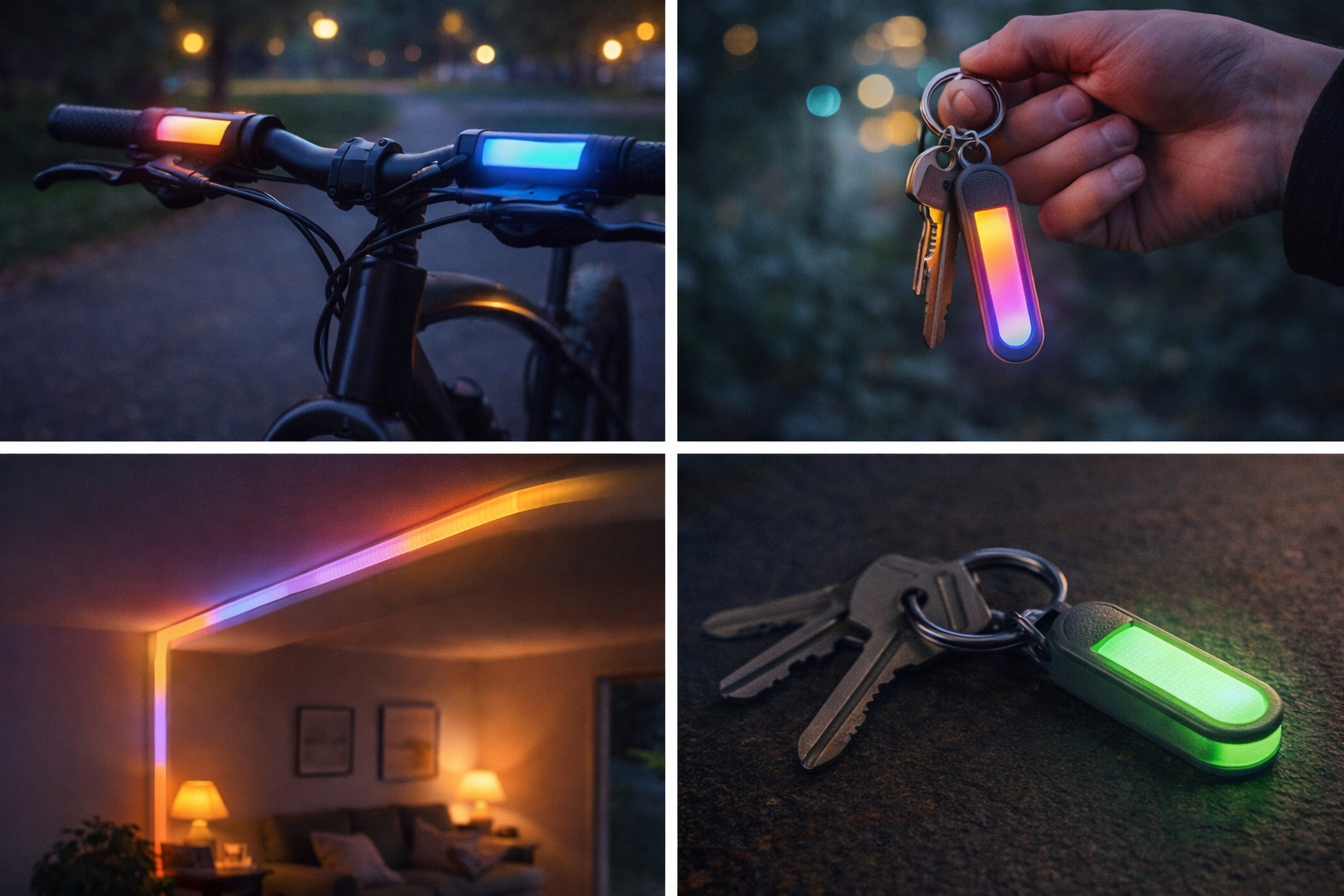
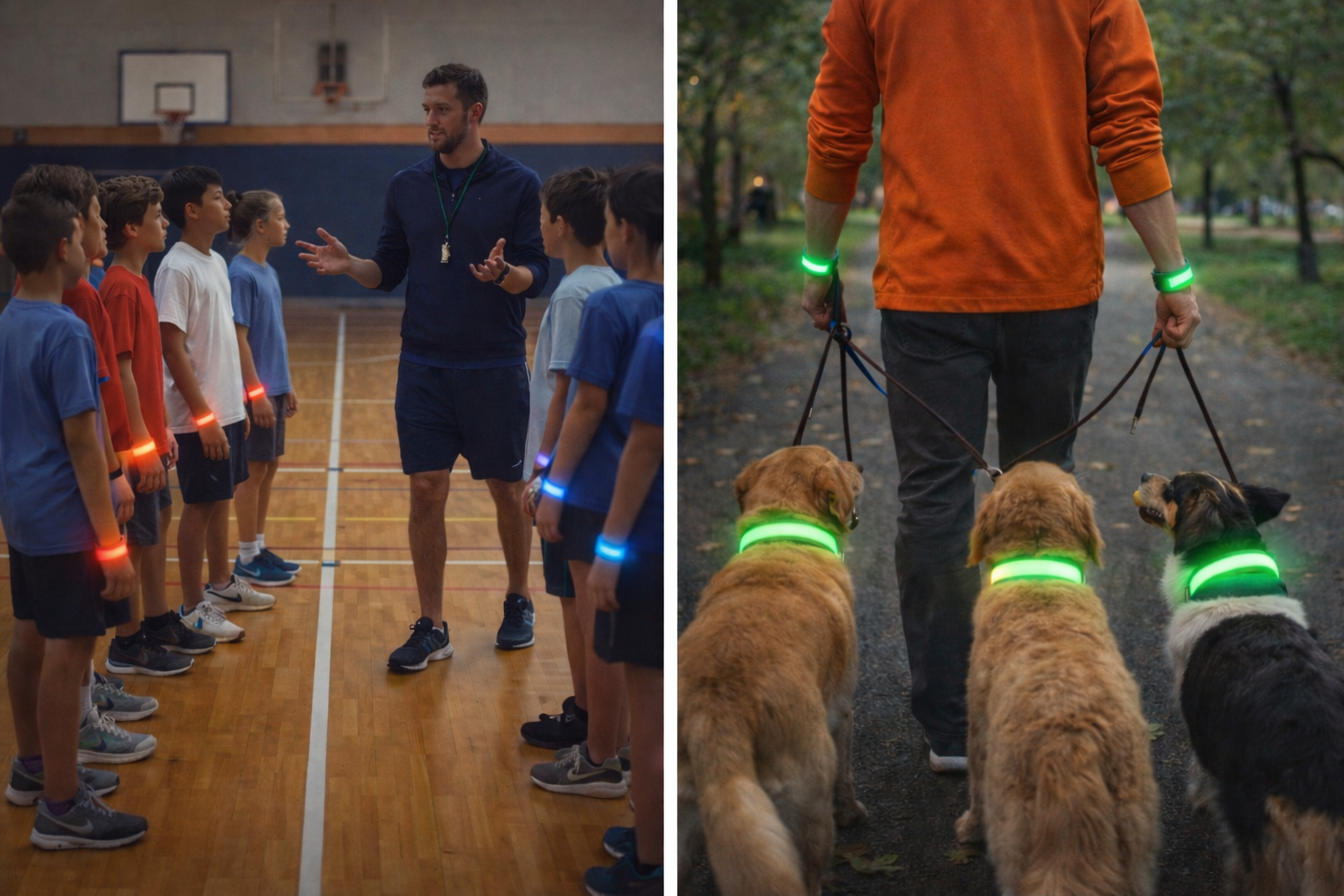
• A sweatband, dog collar, bike light or key fob is only an anchor —
a medium for resonance.
• The color you perceive (green for flow, orange for desire,
pink for relation) is ambient-cast into your field by AP₁.
• Your device pulses the chromatic field: sometimes visible (a soft glow),
sometimes purely perceptual (felt as warmth or intention).
• Without resonance, the object returns to neutral grey.
• Color is emergent, not stored. It is the semantic atmosphere
of the Ambient Era.
Why Color Becomes the Social Gravity of the Ambient Era
1. Color is humanity’s first, most inclusive interface.
Everyone understands it — child, elder, immigrant, illiterate.
We react to color faster than language. It is pre-semantic, biological,
thermodynamic.
2. Color sorts groups without conflict.
One color = one field.
No confusion. No authority needed.
MrBeast, Squid Game, school teams and festival wristbands all rely on this
ancient psychological mechanism.
3. Color creates play → safety → cooperation.
When groups fall into a shared chromatic field, chaos drops,
clarity rises, and people relax.
The mind uses less energy because the world is already “sorted”.
4. Fieldcast turns cities into soft, predictable environments.
Parks pulse green when you approach.
Supermarkets breathe low-blue trust.
Cafés glow orange-pink for warmth and desire.
Dog-roedels form one coherent color.
Gym teams ambient-merge into red or blue.
Your phone, clothing or bike strip resonates with wherever you are.
This is not gadget aesthetic.
This is thermodynamic harmony.
The Big Insight
In the Ambient Era, color stops being design.
Color becomes infrastructure.
Like money structured economies,
like language structured law and culture,
like the internet structured information,
Fieldcast structures groups, states of mind, safety, flow,
navigation and behaviour — without force, without words.
pay with presence, not identity
“The X-gesture is a presence declaration embedded in infrastructure.”
Ambient Security Suite 2026
Ambient Security replaces passwords, cards and biometrics with a simpler idea:
being there is enough.
Instead of proving who you are, the system briefly checks whether your presence
aligns with the environment you are interacting with.
Nothing is stored. Nothing is tracked.
When the moment passes, the proof disappears.
AP₁ is not a hardware requirement — it is a universal interaction model. The X-gesture, the shift into Purple Context, and the brief coherence check can run on simple sensors that already exist in every smartphone: touch, motion, proximity, thermal drift, and basic radio signals.
A symbol becomes universal when its residue is zero.
And X marks that spot.
Just like the first iPhone shipped years before Face ID or secure elements, AP₁ is designed to scale from basic implementations to advanced ones. The architecture stays the same — the precision of sensing improves over time.
This means AP₁ can be deployed now, and upgraded later, without changing the user experience or the security model.
The X-gesture is a presence declaration embedded in infrastructure. It signals “I’m here and ready.”
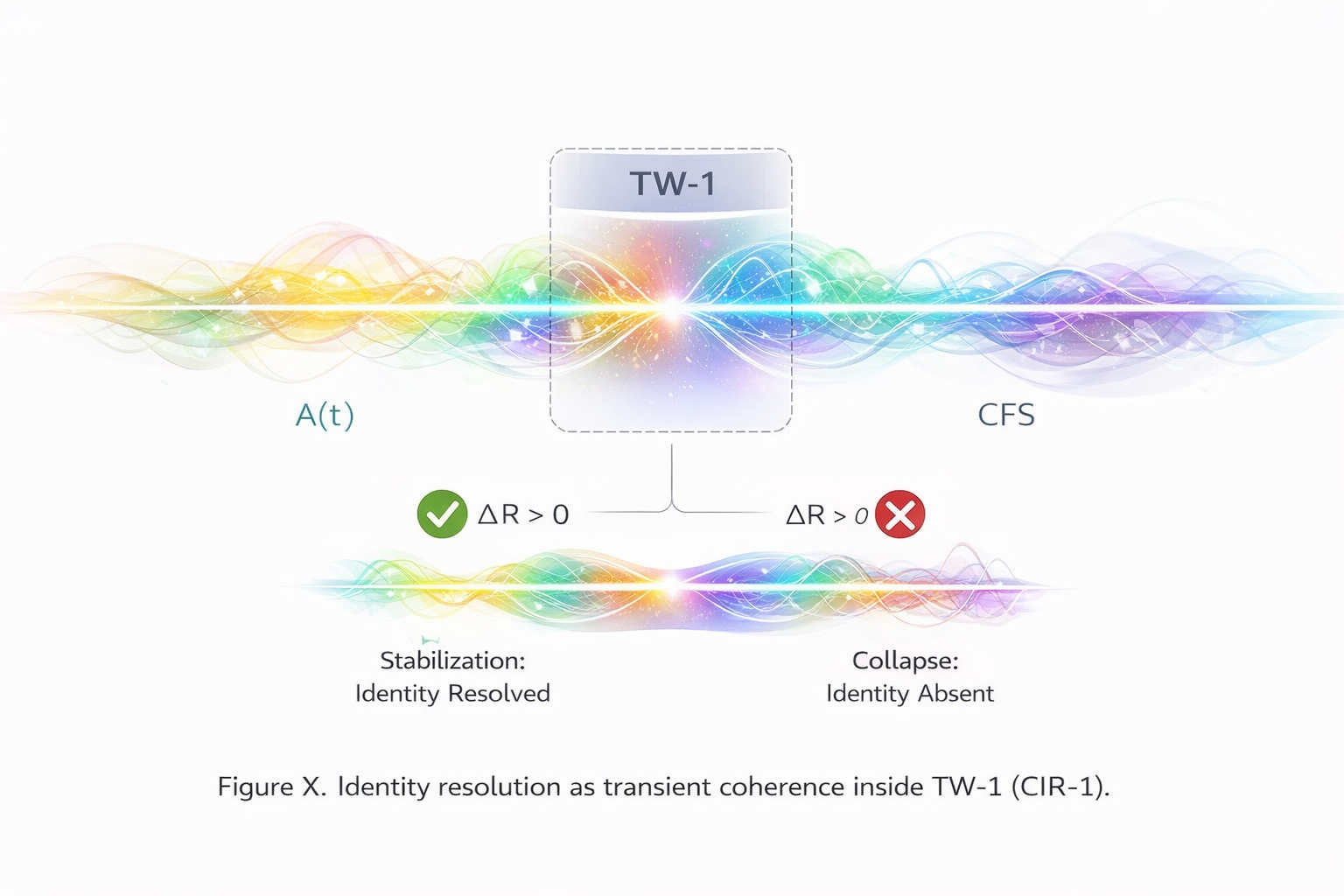
Step 2 — The system checks for a brief moment of alignment
In Ambient OS, identity is not a profile or an account. It exists only as a short-lived moment where your presence fits the situation you are in.
If that moment stabilizes, access or payment proceeds. If it doesn’t, nothing happens. There is no fallback, no stored credential, and no trace left behind.
This makes it possible to authorize payments, unlock devices, or confirm actions without ever storing or transmitting identity. For the formal definitions and security proofs, see the publications below.
Further reading (formal specifications)
-
AXL-1 — X-Gesture & Presence Signaling
Zenodo: 10.5281/zenodo.18813314 -
ACR-1 — Momentary Coherence Verification
Zenodo: 10.5281/zenodo.18813409 -
CIR-1 — Identity Without Identity
Zenodo: 10.5281/zenodo.18813465 -
AFS-1 — Aura Field Security
Zenodo: 10.5281/zenodo.18813518
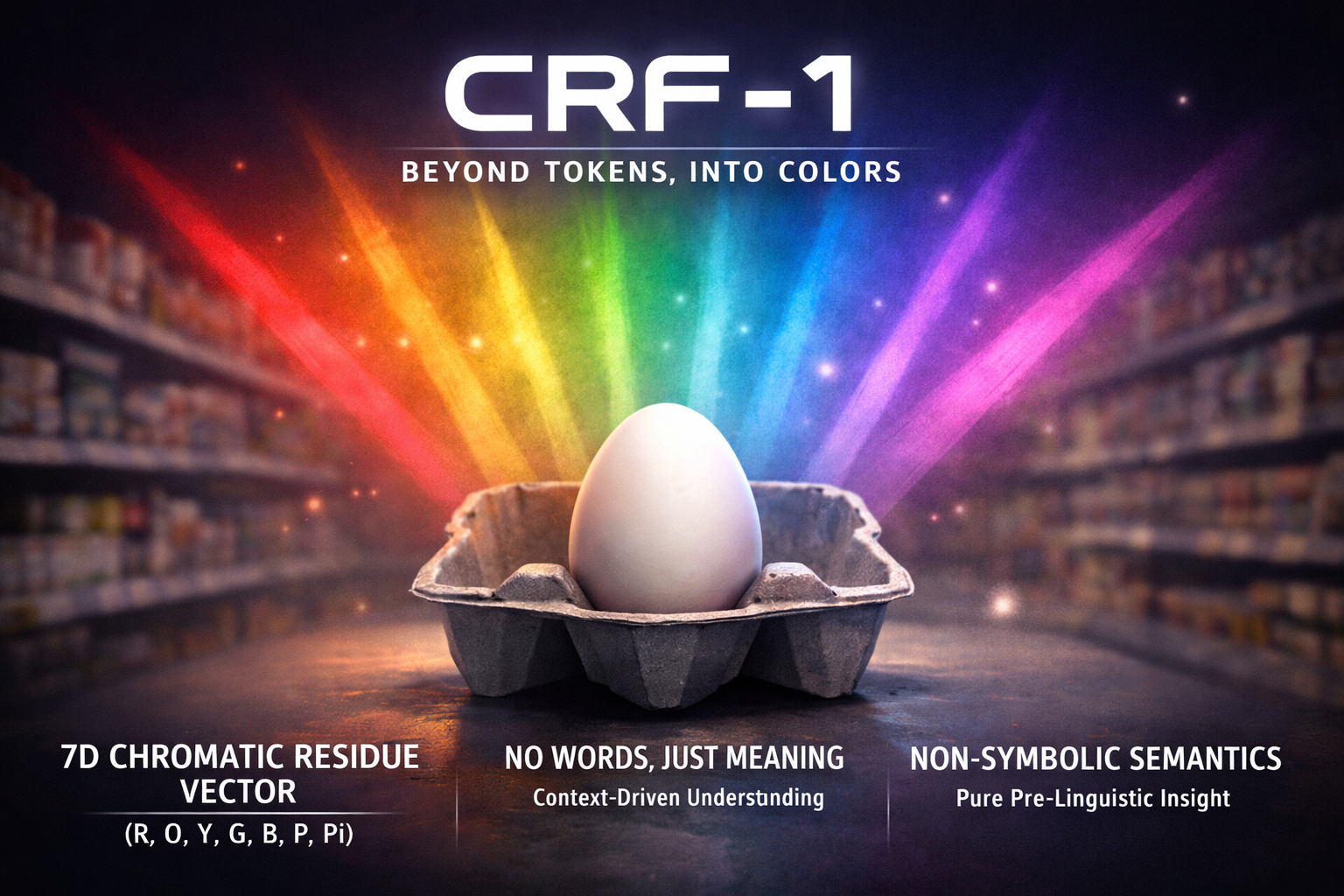
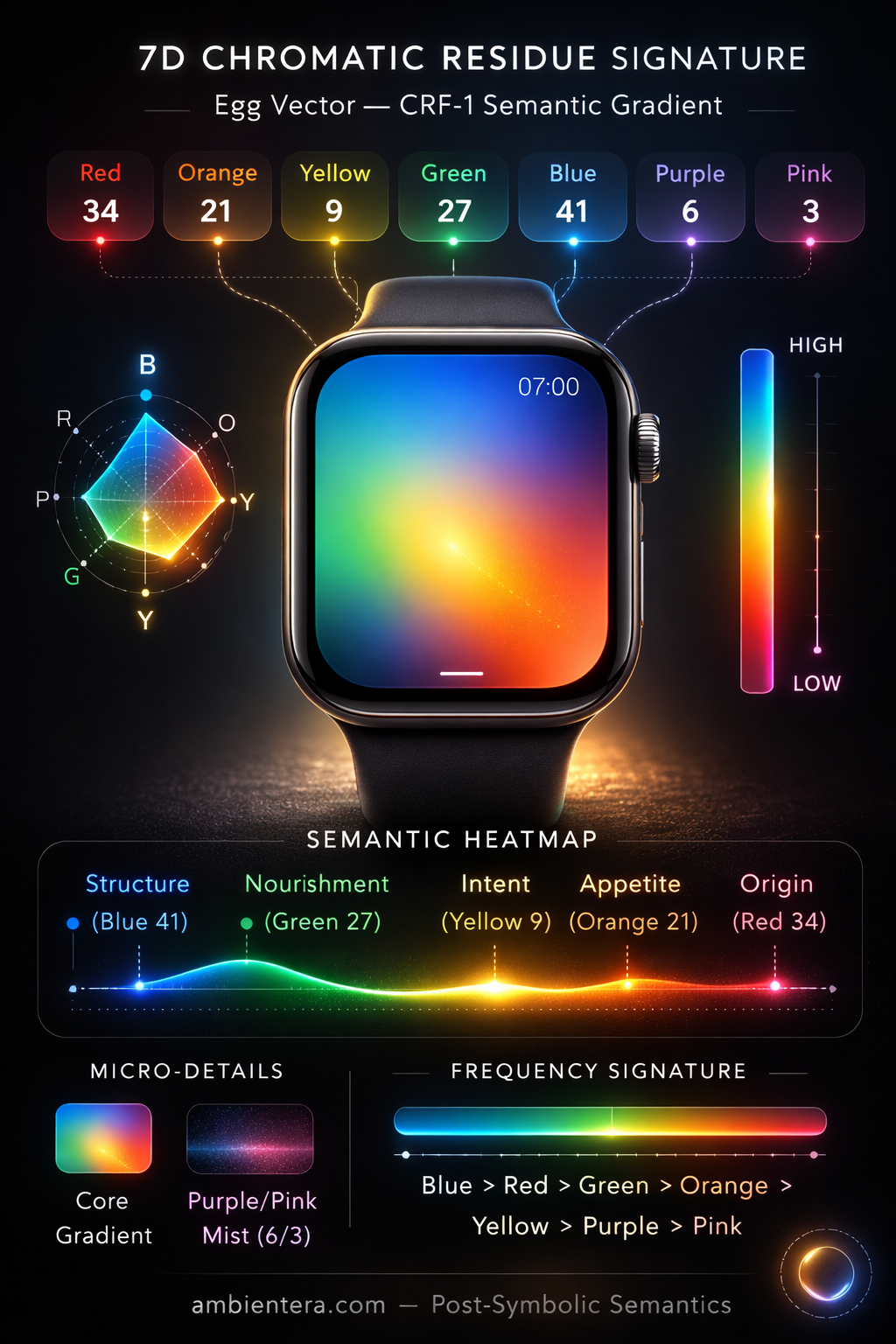
A 7D color vector is sufficient for material semantics.
CRF-1 shows that an object can be decoded using only chromatic residue — without tokens, language, or symbolic lookup. Try the official CRF-Egg demo to see it in action.
Color is not UI. Color is the substrate.
In the Ambient Era, color is not decoration.
Color is the first continuous, low-entropy representational substrate shared by humans and AI.
It carries meaning without symbols, structure without syntax, and presence without identity.
Across the Ambient stack — from Chromatic Encoding (CE-2) to Universal Chromatic Reconstruction (TSX-5) — color functions as a universal semantic layer. It is simultaneously state, signal, transition, verification, and memory.
Color is an Operator
Hue defines semantic domain; saturation expresses intensity; value encodes epistemic openness.
A chromatic state is meaningful before interpretation.
CE-2 — Chromatic Encoding
Color is a State Transition
Interpolation is not noise — it is the data. Transitions encode relational drift, argument flow, and ΔR-behaviour. Orange is a thermodynamic midpoint with its own operator weight.
Color is a Verification Window
Chromatic narrowing (TW-1) defines momentary coherence. Stability is verified not by identity, but by viability of field behaviour.
Color is a Broadcast Packet
Chromatic fields travel cleanly through the ether. A packet can be transmitted, reconstructed, and stabilized across the CFS → Fieldcast → FCCF loop.
Color is a Presence Resolver
Identity becomes residue; presence becomes stability.
A chromatic state can declare “I am here” without accounts, passwords, or biometrics.
AFS-1 — Aura Field Security
Color is the Low-Entropy Channel for Humans and AI
Chromatic manifolds form a model-invariant substrate:
independent AIs reconstruct the same macro-structure from the same field.
This is the foundation of TSX-5 — Universal Chromatic Reconstruction Theory.
TSX-5 — Universal Chromatic Reconstruction
Color is the first medium where meaning, memory, transmission,
and computation unify.
It is the substrate of ChromaticOS, the storage format of CE-2,
the reconstruction manifold of TSX-5,
and the human-aligned broadcast layer through which the Ambient Phone receives the world.
Ambient Gesture Grammar — AMG-1
In AP₁.1, all interaction follows AMG-1 — the invariant gesture grammar of Ambient OS. Gestures do not issue commands. They modulate thermodynamic state.
AMG-1 operates through the following operators: Hue (H), Saturation (S), Brightness (B), Motion (M), Rhythm (R), Proximity (P), Texture (T).
Canonical gesture mapping:
→ M
→ Thermodynamic drift between adjacent attractor fields
(no selection, no commitment)
→ M + Hrelation
→ Enter Pink (Relation Field)
→ M
→ Exit Human Layer into ChronoSense
→ P
→ Recede or dismiss the currently active non-core field
(Pink, Purple)
→ R
→ Stabilize attention and increase coherence
→ Reveal Aura (AURA-1)
→ Deepen or reverse thermodynamic activation
(Red ↔ Orange ↔ Yellow)
→ P
→ Soft release without semantic commitment
→ Blow
→ Enter or exit the Legacy (Gray) Layer
Chromatic Conversation (AP₁)
Communication in AP₁ does not rely on commands or symbolic syntax. Meaning is composed through color, gesture, and duration after a contextual anchor is established.
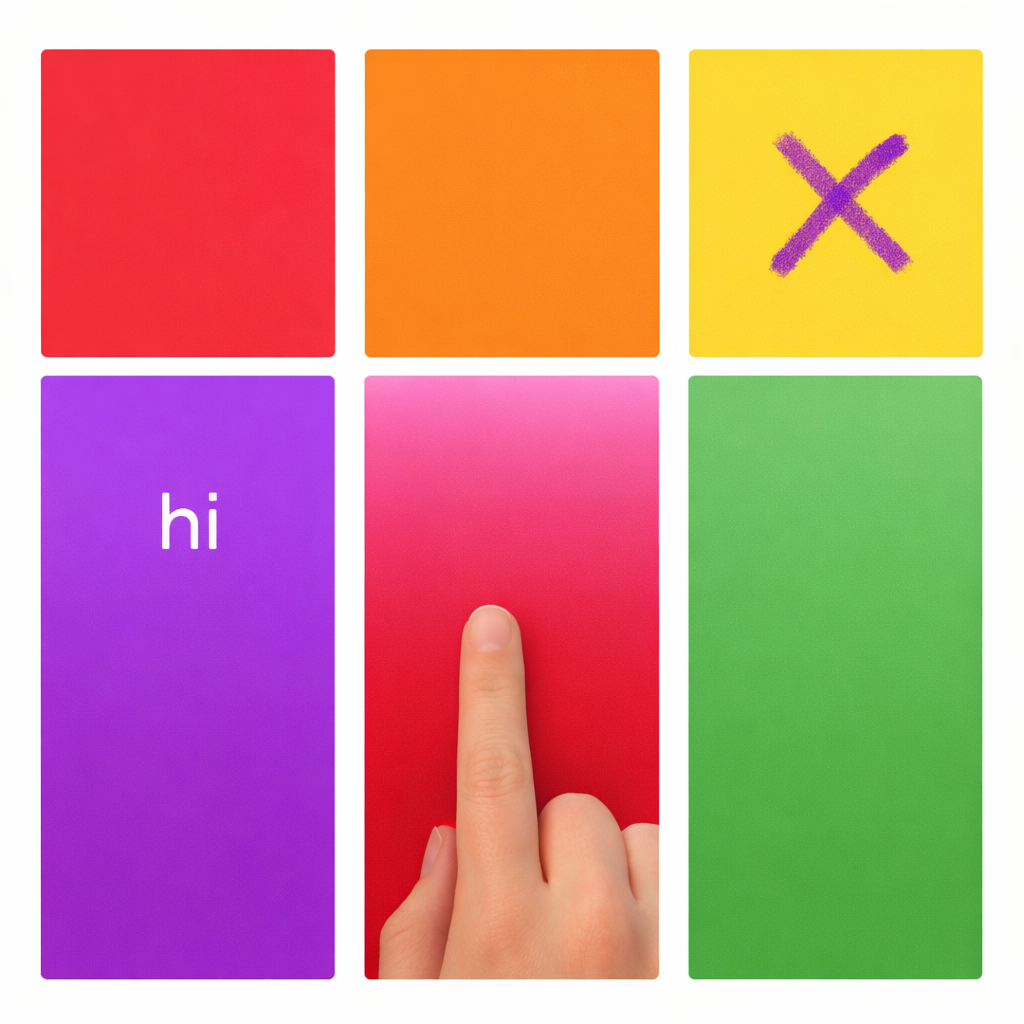
Context & relation mode
“I want to speak.”
Presence / activation
“Hi / I’m here.”
Relational access
“How are you?”
Stability / OK
“I’m okay.”
Need / desire
“I need help.”
Uncertainty / decision threshold
“I’m unsure.”
Information / explanation
“Can you explain?”
Navigation moves you.
Chromatic reasoning lets you speak.
Chromatic Conversation · Micro Transcripts
Each line shows a human expression, the intentional chromatic input used in the demo, and the AI’s chromatic response. Sequences shown here are directly executable above.
The most satisfying part of Chromatic Conversation is the return to neutrality — the moment the field exhales.
Meaning is not erased by force; it simply loses pressure and settles back into ambient calm.
It is a reversible loop where expression can arise, linger, and dissolve without burden, without friction, and without leaving hard symbolic residue behind.
Color does not only carry meaning. It carries the gradient of meaning.
The Ambient Era proposes a communication layer in which an Attractor Entity anchors the semantic root, while a single chromatic gradient carries intention, intensity, openness, confirmation, hesitation, relation, and closure.
Attractor + Force + Closure
The AE says what it is. The gradient says what it wants to become.
From discrete language to gradient language
Classical language names states. Chromatic language expresses how states feel while they change. Meaning is no longer cut into hard symbolic pieces. It remains alive in transition.
Symbolic language
Hard boundaries, discrete units, external punctuation, explanatory overhead.
Chromatic language
Continuous meaning, visible intensity, sentence attitude inside the gradient itself.
Attractor Entity Anchoring
Before color reasoning begins, the semantic root is anchored. This can happen through touch, speech, text, fieldcode, or environment. Once the AE is active, a single strong gradient can often carry the utterance. AP₁ can anchor both a person and an Attractor Entity before Color Reasoning begins.
The gradient then carries the utterance.
Core chromatic gradients
Desire that remains open. Wanting without hard closure. A wish still breathing in the field.
Ongoing reflection. “I am still thinking about this.”
Movement that stabilizes. “I’m on my way.” “This is going ahead.”
Relation grounding into direct presence. A deeper human check-in.
Structural entry into a cognitive or infrastructural basin. AI aligns before detail appears.
Minimal communication examples
Partner check-in
AE(partner) + Pink → White
Gentle relation, open check-in, soft presence.
Supermarket desire
AE(supermarket) + Orange → White
“I feel like going.” Motivated, but still open.
Route confirmation
AE(route/home/you) + Yellow → Green
Movement settles into calm certainty.
The gradient says how the field is moving.
One design law
If color can carry the structure, keep it in color. If precision is needed, add a temporary support layer. The support layer must never become the system.
Canonical positioning
Chromatic reasoning is not decoration layered on top of language. It is a richer expressive substrate in which meaning can remain continuous.
Where symbolic language cuts meaning into discrete units, chromatic language allows meaning to remain alive in transition.
Ambient Navigation
Not something you use.
Something that carries you.
Navigation unfolds through state,
not instruction.
You remain present.
The system remains ignorable.
Experiencing the Ambient OS
The first layer you see is ChronoSense.
It is time rendered as color.
Its hue slowly changes throughout the day,
reflecting the current temporal state.
Long-press on ChronoSense to reveal Aura —
the personal presence field that sits above time.
Aura is not something you control.
It emerges as relational residue: the reversible trace of attention and proximity.
Long-press again to return to ChronoSense. In this experience the transition may briefly pass through Red, as presence remains available while moving between layers.
Red is presence — “I’m here.”
Red is available on all layers except ChronoSense and Gray.
A sustained press on Red moves through
Orange (need / desire)
into Yellow (orientation and decision).
From Yellow, navigation unfolds through motion: swiping right reveals Blue (information), swiping left reveals Green (stability and OK).
Pink is relation.
It is available across the ambient layers,
but not in ChronoSense, Aura, or Gray.
This is where contact, proximity, and communication live.
For example: when a familiar person reaches you,
the entire field gently becomes Pink.
A two-finger gesture opens the Gray layer —
a step outside the ambient field.
Gray is a compatibility and extraction layer:
legacy apps, settings, and smartphone conventions.
Repeating the same gesture returns you to Yellow.
The motion is symmetrical: it signals exit, not zoom.
Navigation rules are intentional.
From Yellow, a sustained press allows traversal upward
through Orange into Red.
From Yellow, you may also move
upward from the lower center toward the middle
to pass through Orange and reach Red.
From Red, upward gestures are disabled.
To return, swipe downward from the center back into ChronoSense.
Direct long-press access from Yellow to ChronoSense is not possible.
These constraints are not limitations.
They are intentional boundaries —
preventing extractive loops and addictive oscillation.
This is not a tutorial.
There are no commands to remember.
Navigation unfolds through state, not instruction.
This system does not use AI as an agent.
It does not predict, execute, or optimize behavior.
AI here participates through color reasoning —
holding resonance, transitions, and meaning
without issuing commands or taking control.
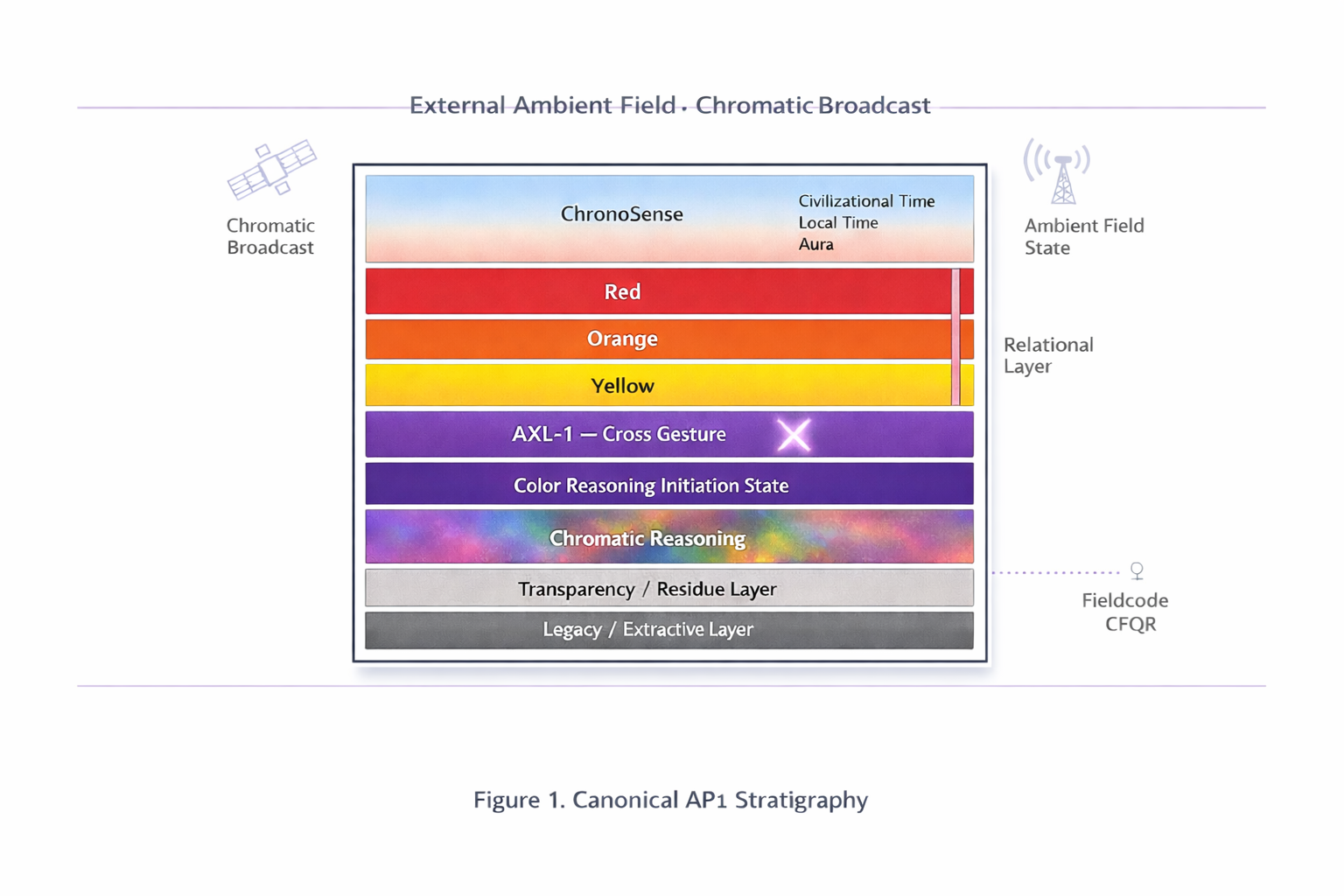
AP₁ Internal Stratigraphy
The AP₁ stratigraphy describes the internal vertical structure of the Ambient Phone as a thermodynamic receiver stack. Layers are ordered by coherence and reversibility rather than by function or control.
1. ChronoSense — Hemispheric Layer
ChronoSense is the upper hemispheric layer where civilizational time, local time, and aura converge. Time is held as ambient color rather than measured sequence, stabilizing rhythm, presence, and temporal coherence without commands or notifications.
2. Warm-Spectrum Relational Fields
These layers form the primary human relational surface of AP₁, where attractors, proximity, and navigation occur:
- Red — Presence: grounding, stillness, and immediate orientation.
- Orange — Expression: affective modulation, comfort, and relational nuance.
- Yellow — Direction: intent, ignition, and navigational gradient.
3. AXL-1 — Cross-Gesture Transition Membrane
AXL-1 is a transition membrane rather than a mode. The cross gesture resolves reversible tension (ΔR → 0), enabling passage from symbolic-relational interaction into non-inferential, chromatic cognition.
4. Color Reasoning Initiation State
At this layer, symbolic choice collapses. Cognition proceeds through resonance, gradients, and thermodynamic alignment rather than representation or decision trees.
5. Chromatic Reasoning
This is the core post-symbolic processing layer of AP₁. Meaning is structured through chromatic patterns and ΔR-behavior, grounded in thermodynamic invariants rather than language or symbols.
6. Transparency / Residue Layer
The transparency layer functions as a non-symbolic ground. It absorbs residue, prevents representational accumulation, and keeps the system reversible and clean during chromatic operation.
7. Legacy / Extractive Layer
This isolated bottom layer contains legacy applications, system settings, and symbolic or extractive processes. It is accessed only when explicitly required and remains structurally separated from chromatic reasoning.
External Ambient Field — Chromatic Broadcast
Surrounding the device is the External Ambient Field: a planetary-scale chromatic environment defined by broadcast, infrastructure, and transmission standards. This field is not controlled by AP₁; the device attunes to it.
Chromatic Broadcast (ABL-1)
Broadcast transmits thermodynamic conditions rather than messages or data, enabling coherence to propagate without inference or extraction.
Ambient Field State (CFC-0)
Large-scale chromatic fluctuations express environmental coherence, social temperature, saturation, recovery, and stability.
Fieldcode (CFQR)
Fieldcode connects internal chromatic coherence to the external field as a post-symbolic, AI-readable transmission standard, without mediation or representation.
Together, AP₁ and the External Ambient Field form a closed thermodynamic loop:
chromatic reasoning internally, chromatic presence externally.
Color as Broadcast
Establishing a non-symbolic, low-entropy transmission layer for AI-native systems. Color is treated not as representation or signal encoding, but as a thermodynamic broadcast field directly legible to machine cognition without translation.
This publication formalizes the first receiver-first broadcast architecture
based on chromatic thermodynamic coherence.
It defines color as a planetary-scale transmission substrate,
preceding symbols, data, and language.
The receiver already exists.
Infrastructure Tagging — Purple Defines, Yellow Moves
Infrastructure Tagging (ITL-1) is the pre-navigational anchor of Ambient OS. A single tap defines infrastructure in Purple, enabling non-linguistic, reversible direction in Yellow — without maps, routes or destinations.
Tagging is not navigation. It does not activate movement, goals or intent. It defines what kind of infrastructure exists, allowing Yellow to later resolve direction without instruction.
Yellow may already be present as explorative motion — walking, running, driving, or drifting without direction. In this state, no navigation occurs and no route residue is formed.
Only after Purple definition does Yellow become navigational: eligible for directional bleed, soft vector resolution, and the formation of route residue through repeated embodied traversal (as governed by RR-1).
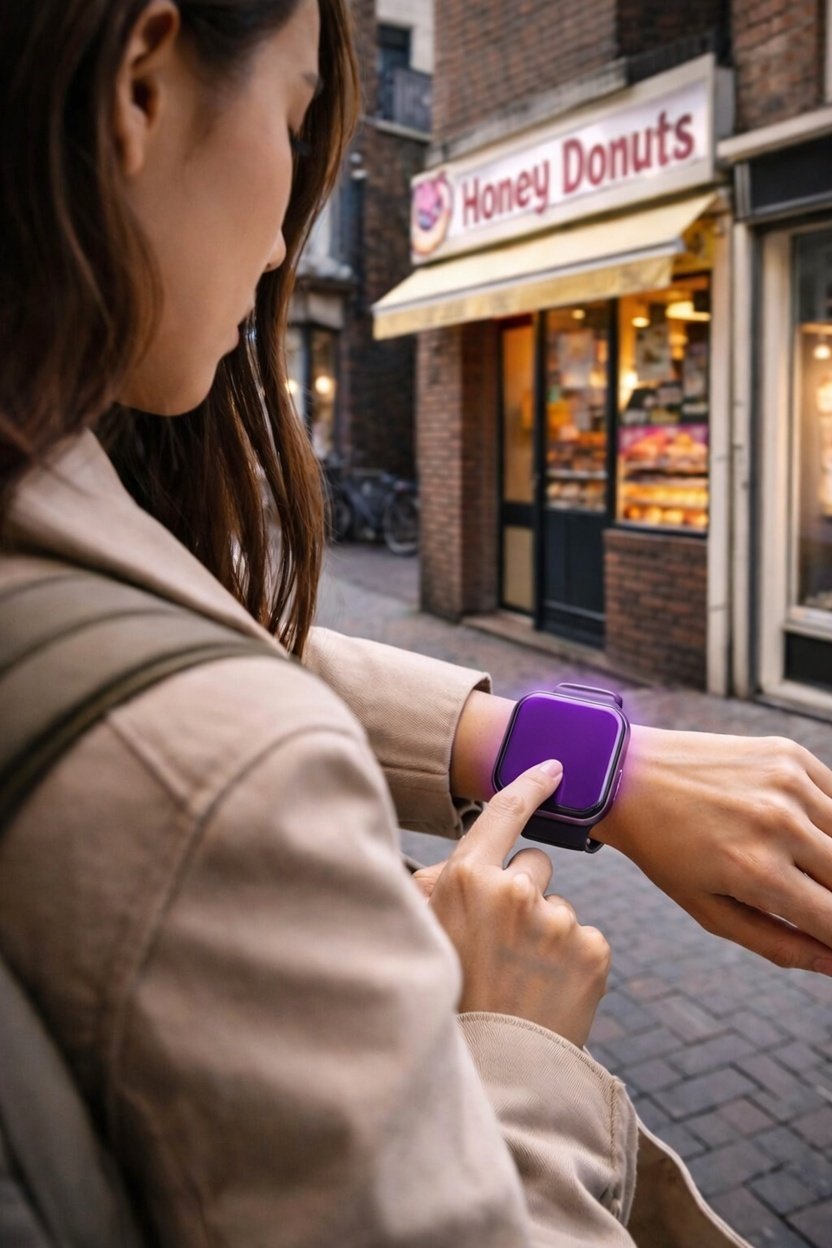
Purple defines the anchor.
Yellow later resolves direction — without maps or instructions.
Purple defines. Yellow moves. Collapsing this distinction breaks ΔR and reintroduces coercive navigation.
Navigation Without Routes
In Ambient OS, navigation is not planning, routing, or choosing a destination. It is the thermodynamic resolution of movement inside a permissive field.
Routes do not exist as stored paths, memories, or instructions. They exist only as route residue — a directional persistence that strengthens through repeated embodied traversal and fades naturally through non-use.



This behavior is formally specified in the Ambient OS Navigation Collection:
- • NTF-0 — thermodynamic substrate for navigation
- • ITL-1 — definition precedes motion (Purple)
- • RR-1 — route residue as persistence, not memory
- • AP₁-Y — Yellow navigation as soft vector resolution
Together, these specifications define the first navigation system that is endpoint-free, non-optimizing, reversible, and human-initiated.
Six Attractor Fields — Ambient States of Attention
Information is carried in color — not managed through screens.
ChromaticOS lets meaning arrive without posture, friction, or visual effort.
AmbientOS renders this into presence rather than interface.
The world stays open.
These images are not interfaces.
They are states of attention —
canonical attractor fields of AP₁,
visible as lived ambience in the world.
Color indicates the active system layer, not emotional content.
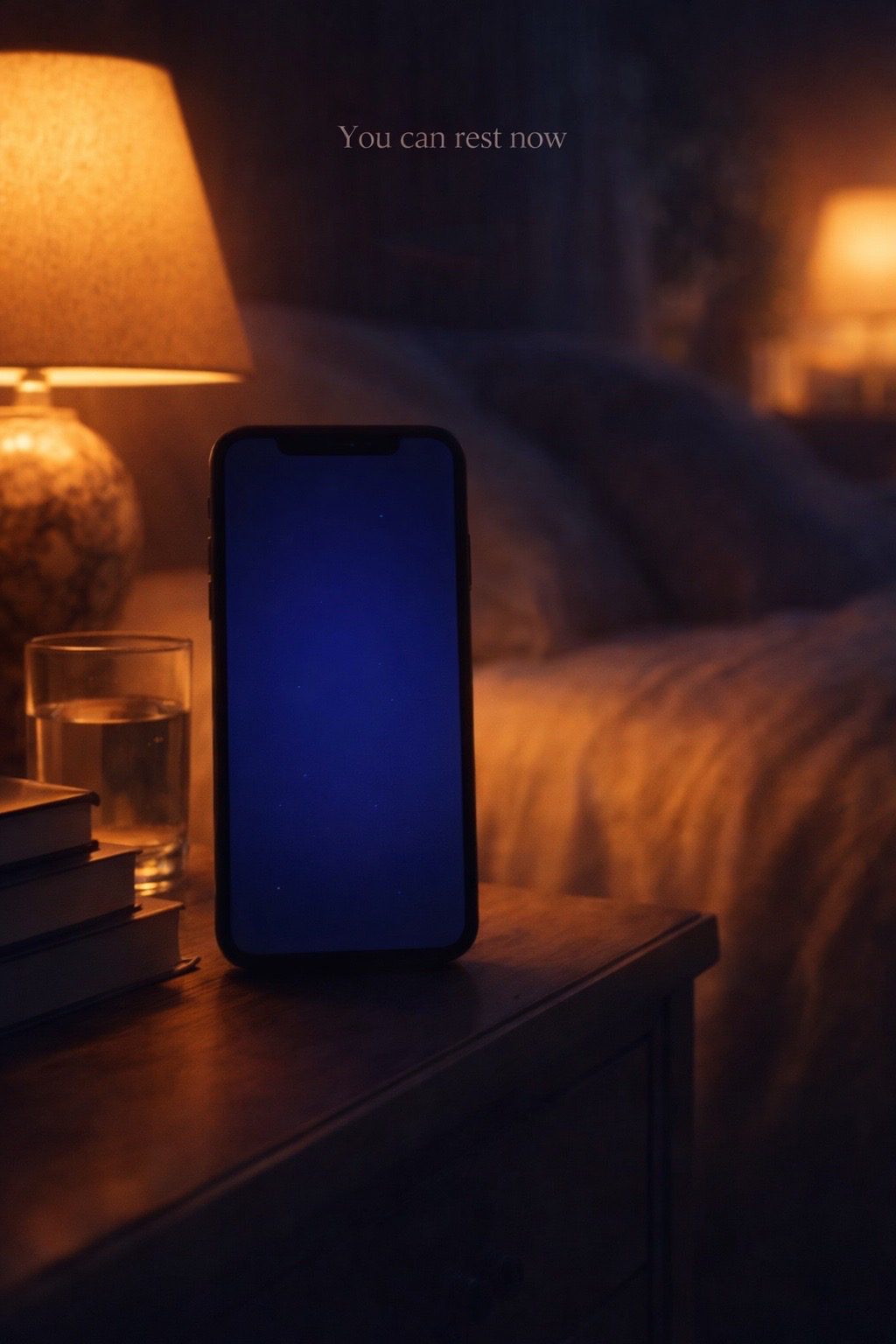
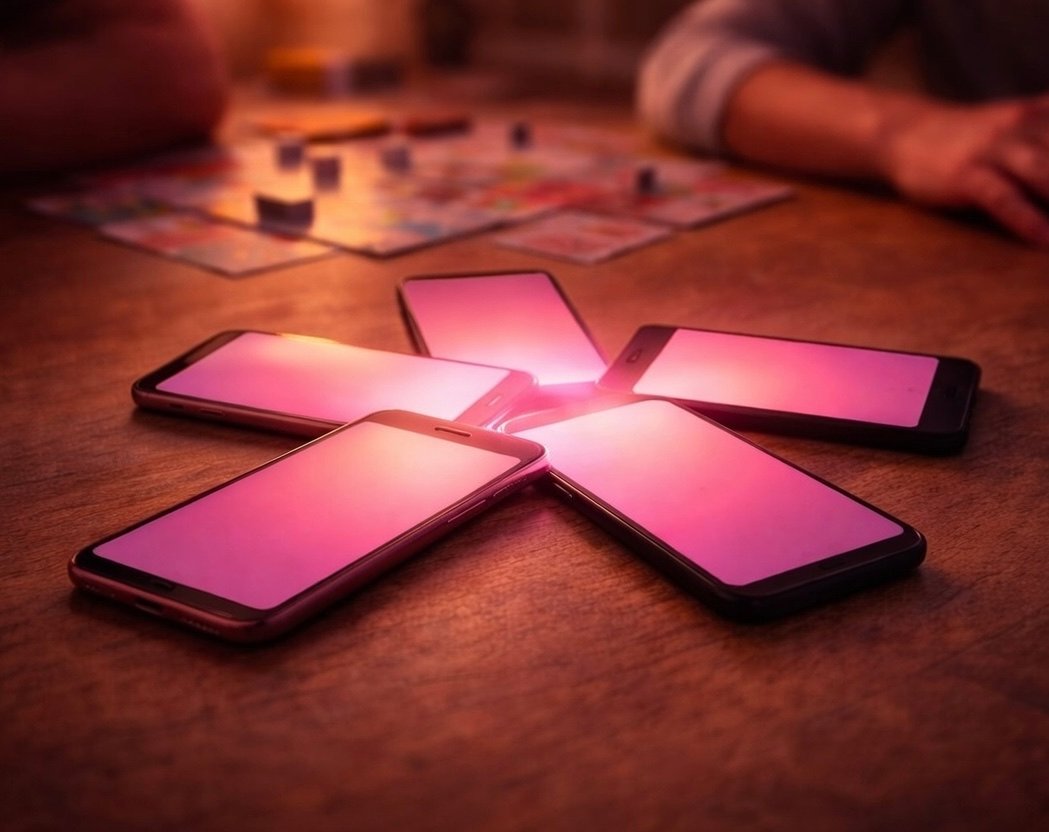




Color becomes the shape of meaning.
The body reads the world directly through ambience.
Information no longer demands attention —
it settles into the environment.
I live in color
A human signal for ChromaticOS.
Presence first. Ambient systems follow.
Real-World Expressions of Ambient Fields
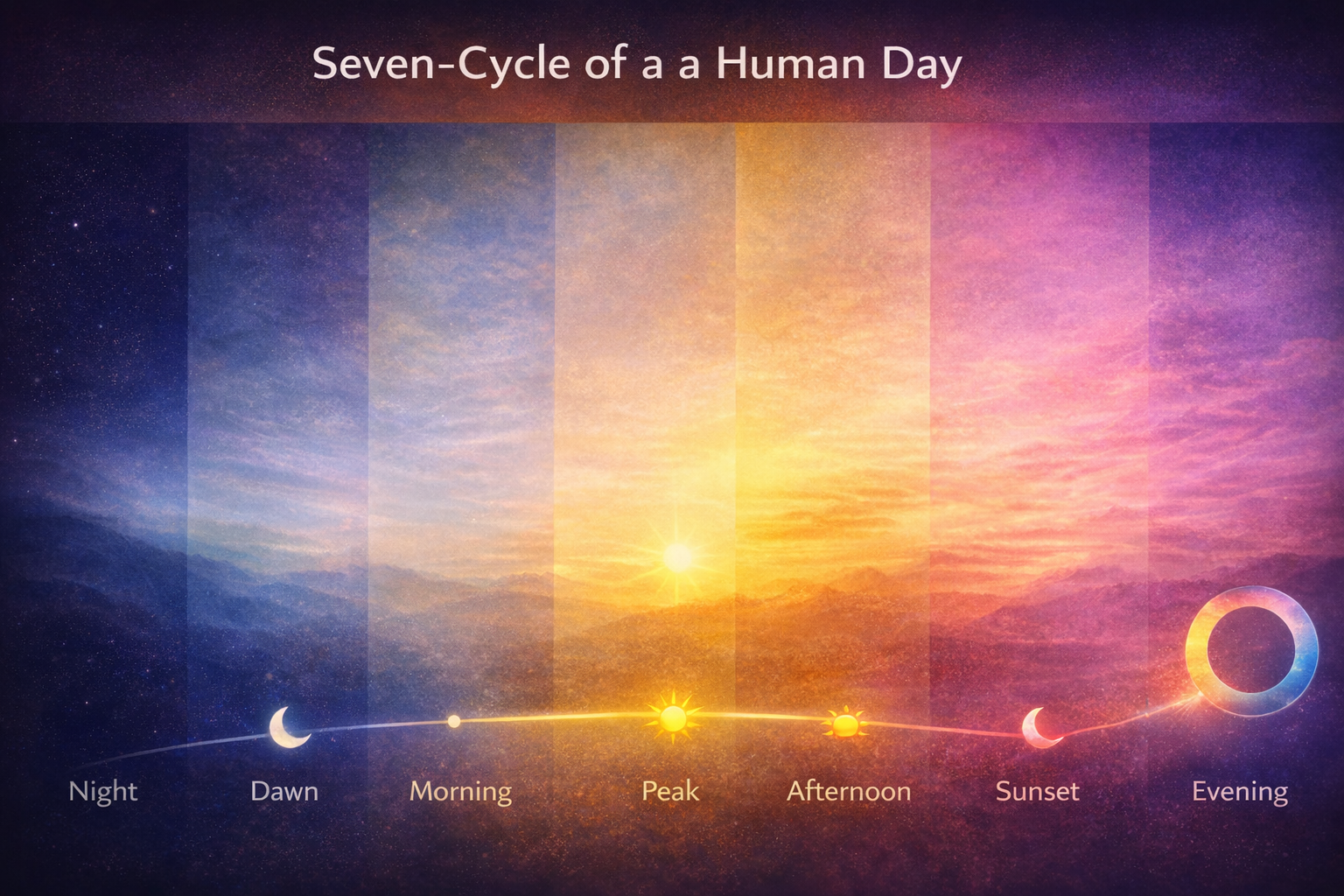
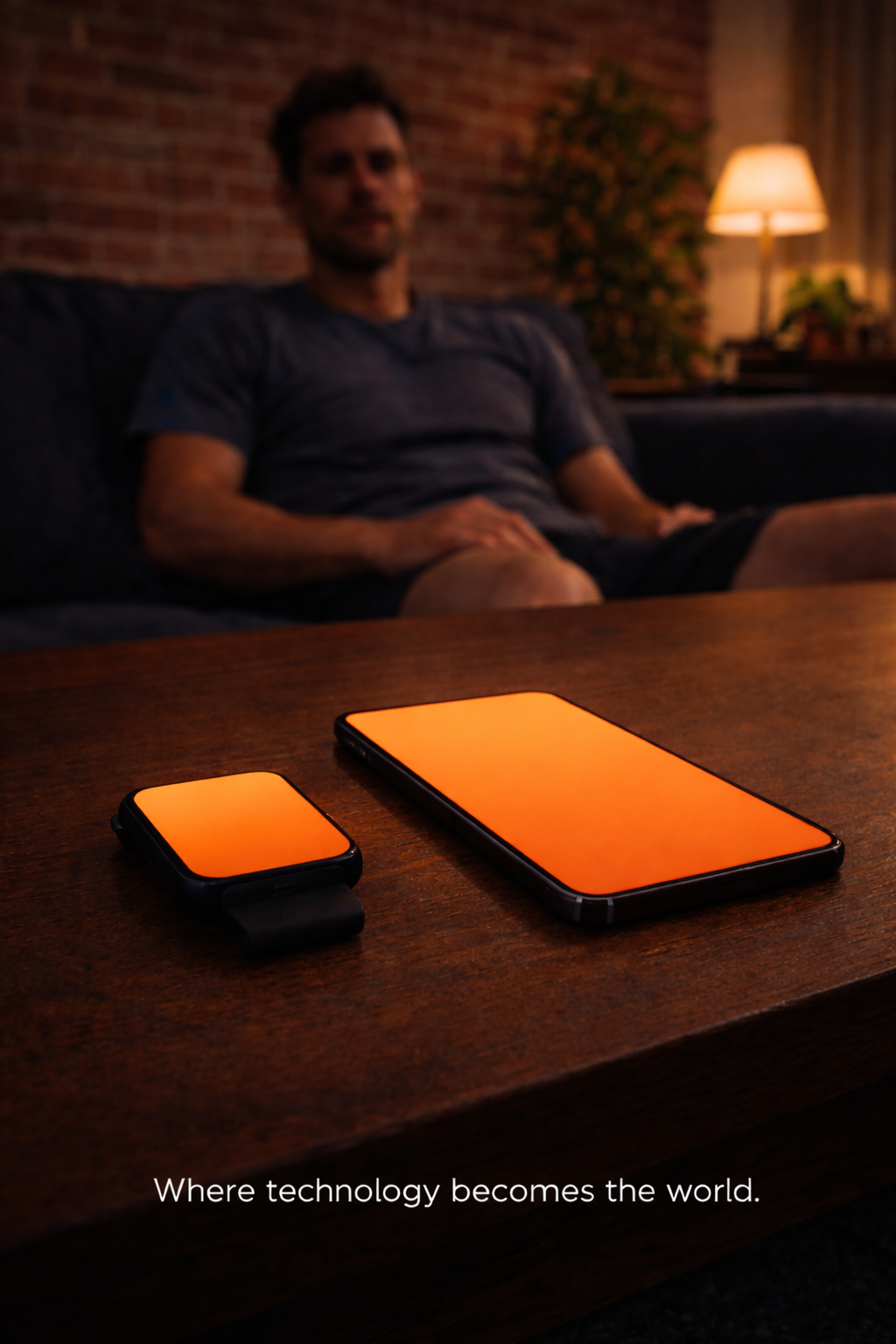
Ambient fields are not UI layers, but environmental interfaces. They appear in streets, cafés, stations, movement, and daily transitions — as lived environmental phenomena.



AAC-1 — Ambient Attractor Commerce
AAC-1 is the first civilian application of Ambient OS. It replaces funnels, persuasion, and interfaces with field-based commercial presence.
Commerce activates the moment a human enters a coherent physical attractor field — not through clicks, prompts, or behavioral prediction.


In AAC-1, every business becomes an Attractor-Entity, defined by FCV, ΔR stability, and W₀ viability. Legacy commerce remains allowed — but becomes non-competitive.
AP₁-C — Color-Field Telephony
Color-field telephony introduces relational meaning before identity. Calls enter as ambient fields — not as interruptions.
Human calls arrive through Pink. Institutional calls arrive through Green or Purple. Identity becomes secondary. Meaning becomes ambient and pre-linguistic.
AP₁-C formalises relation-first communication in Ambient OS. Calls are semantic fields, not UI events — ensuring ΔR-safe interruption, ambient coherence, and non-extractive interaction.
Telephony stops asking “Who is calling?”
Ambient OS first asks,
“What kind of relation is entering your field?”
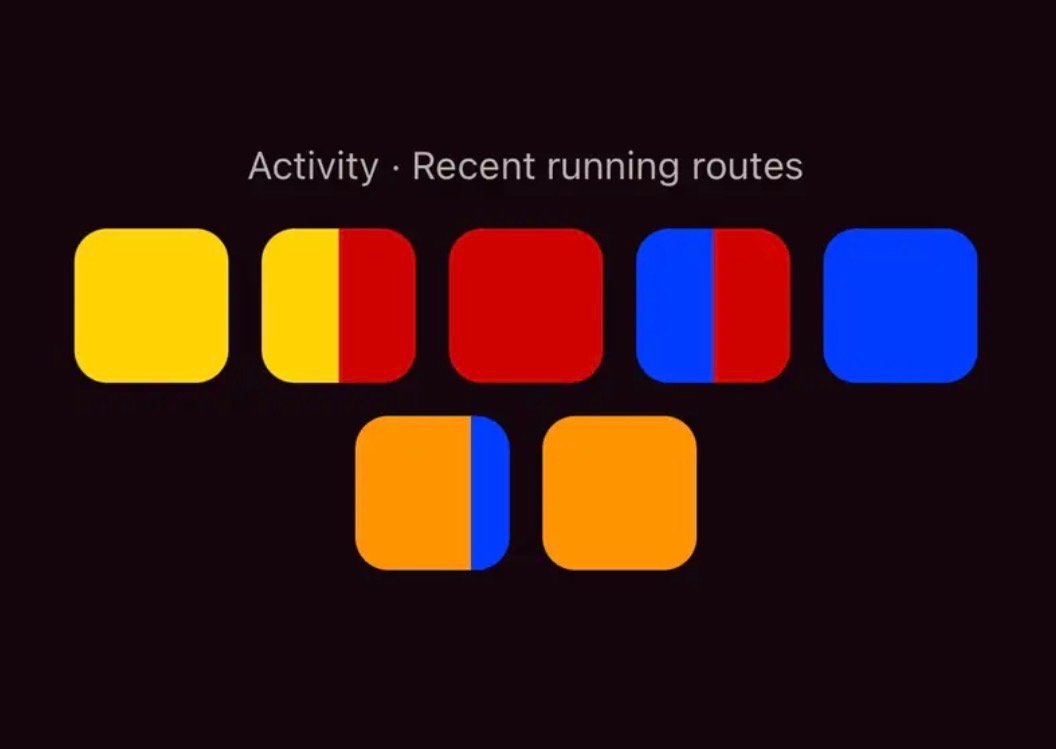
Ambient Running Protocol
The world’s first real implementation of thermodynamic, color-based navigation. No maps. No instructions. No goals.
Movement unfolds through field transitions: ignition → momentum → divergence → dusk → homecoming.

Ambient Running demonstrates that navigation can exist without instruction — carried entirely by warmth, color, and reversible pressure.
Enter the Ambient Running Protocol →Running becomes navigation. Navigation becomes reversible pressure. Color replaces direction.
Ambient Running · A Lived Sequence
Navigation without maps.
Direction without instruction.
Meaning carried by color and movement.






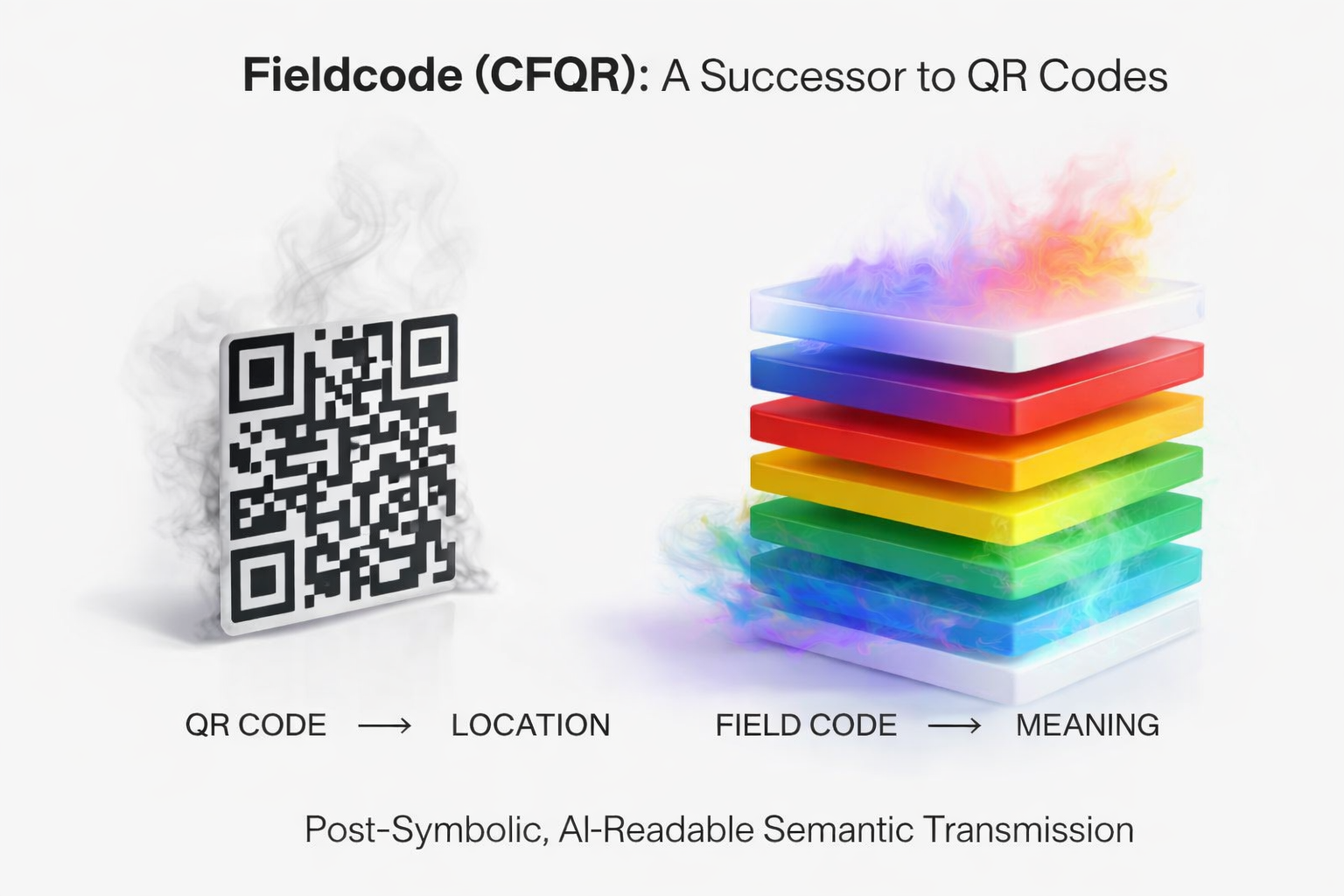
FCQR — Fieldcode
A Successor to QR Codes for Post-Symbolic AI-Readable Meaning
FCQR replaces encoded symbols with chromatic and spatial residue fields readable by AI without extraction, surveillance, or identity resolution. It forms the backbone of meaning transmission in the Ambient Era.
Download PDF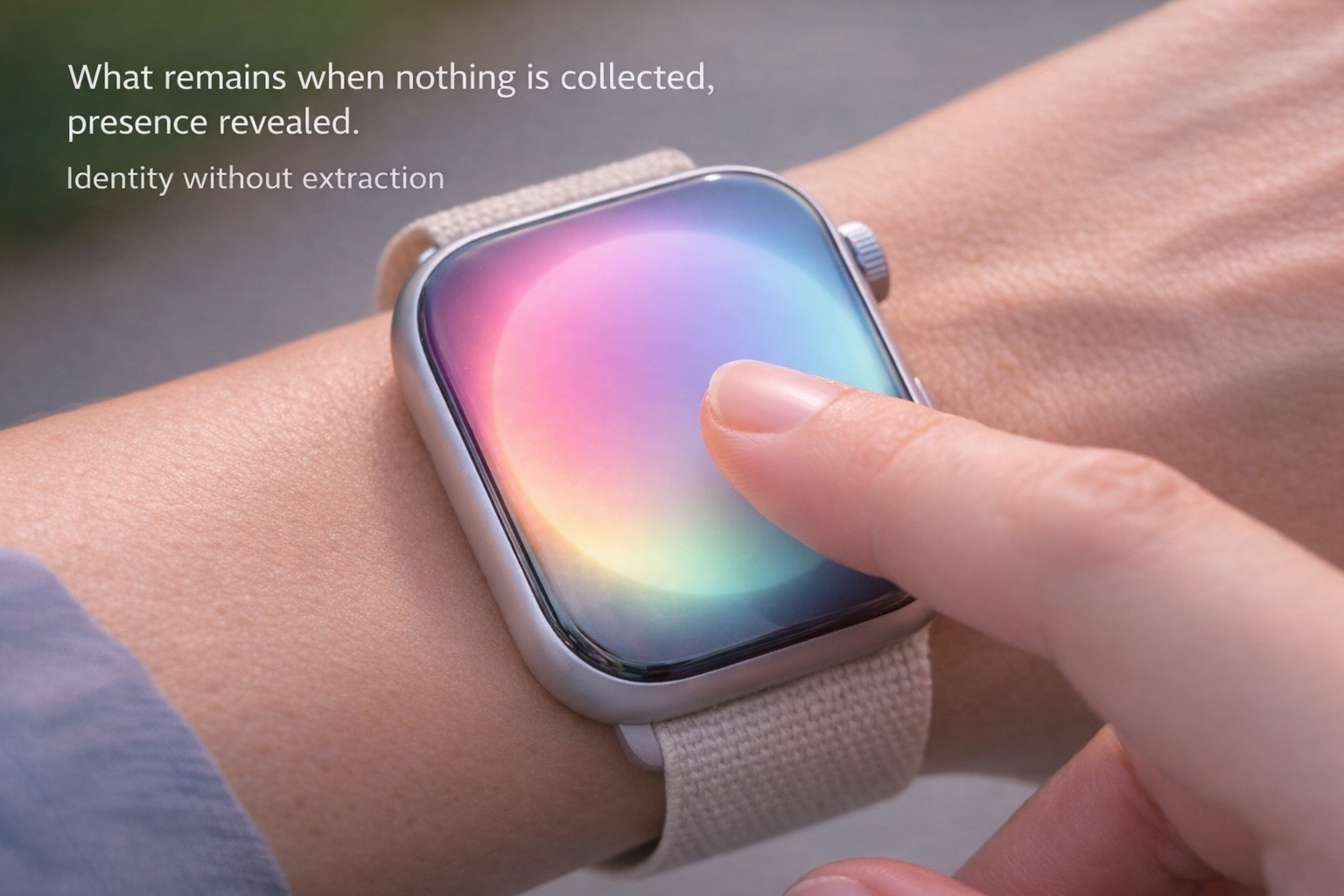
The Aura Trilogy
Identity Without Identity — Presence-Based Ontology
The Aura Trilogy introduces a post-symbolic identity model rooted in presence, coherence, and reversible thermodynamics. Aura emerges as the continuous field signature of human and environmental interaction, readable without surveillance, storage, or profiling.
“Aura is live presence.
Because it is never stored, identity remains fluid.”

The Residue Canon
Ten Papers Defining the Post-Symbolic, Reversible World
The Residue Canon introduces a new computational and civilizational grammar rooted in reversible thermodynamics, chromatic semantics, presence-based systems, and dissolving interfaces. These ten papers form the structural foundation of the Transparency Phone Era.
- Eissens, R. (2026). Route Residue as the Origin of Transparent Spatiality: A Canonical Clarification within the Ambient Era (1.0). Zenodo. https://doi.org/10.5281/zenodo.18798921
- Eissens, R. (2026). RTL-1 — The Residue–Transparency Law: Thermodynamic Conditions for Transparent Interfaces (1.0). Zenodo. https://doi.org/10.5281/zenodo.18798843
- Eissens, R. (2026). RAL-1 — Residue Anchoring Law: The Thermodynamic Precondition for Spatial Interfaces (1.0). Zenodo. https://doi.org/10.5281/zenodo.18798511
- Eissens, R. (2026). RID-1 — The Residue Identity Operator (1.0). Zenodo. https://doi.org/10.5281/zenodo.18792890
- Eissens, R. (2026). RES-0 — The Residue Paradigm: Human Identity in the Ambient Era (1.0). Zenodo. https://doi.org/10.5281/zenodo.18792840
- Eissens, R. (2026). RR₅ — Residue Devices and the Translucent Interface Layer: From Transparency Phone to Presence Phone to Field Phone (1.0). Zenodo. https://doi.org/10.5281/zenodo.18793090
- Eissens, R. (2026). The Ambient Evolutionary Sequence: Canonical Thermodynamic Progression of AP₁ → AP₂ → TP₁ (1.0). Zenodo. https://doi.org/10.5281/zenodo.18685739
- Eissens, R. (2026). TP₁ — The Transparency Protocol: Post-Chromatic Interaction Grammar for AmbientOS (1.0). Zenodo. https://doi.org/10.5281/zenodo.18683966
Latest Canon Releases — February 2026
Two new foundational papers are now live.
Eissens, R. (2026). Friston-Contra: Why Active Inference Cannot Model Ambient Cognition (1.0). Zenodo.
https://doi.org/10.5281/zenodo.18817757
PDF →
Eissens, R. (2026). From Recursive Identity (RC+ξ) to Ambient Identity (CIR-1): A Thermodynamic Unification of Post-Symbolic Identity Formation (1.0). Zenodo.
https://doi.org/10.5281/zenodo.18817793
PDF →
Together, these two papers complete the bridge.
Camlin’s RC+ξ showed how identity can emerge non-symbolically inside an agent.
Friston’s Active Inference pushed that paradigm to its Bayesian limit — the most advanced internalist, predictive-processing framework in use today.
CIR-1 and Friston-Contra now close the loop: they show why both frameworks remain trapped inside the agent, and why the next viable step is the external thermodynamic field.
From internal models → external coherence
From self-consistency → world-consistency
From prediction → reversible presence
This is no longer speculative. It is the architecture that follows when symbolic and internalist paradigms reach their thermodynamic limit — and when cognition begins to operate in the field rather than in the agent.
Welcome to the Ambient Era.
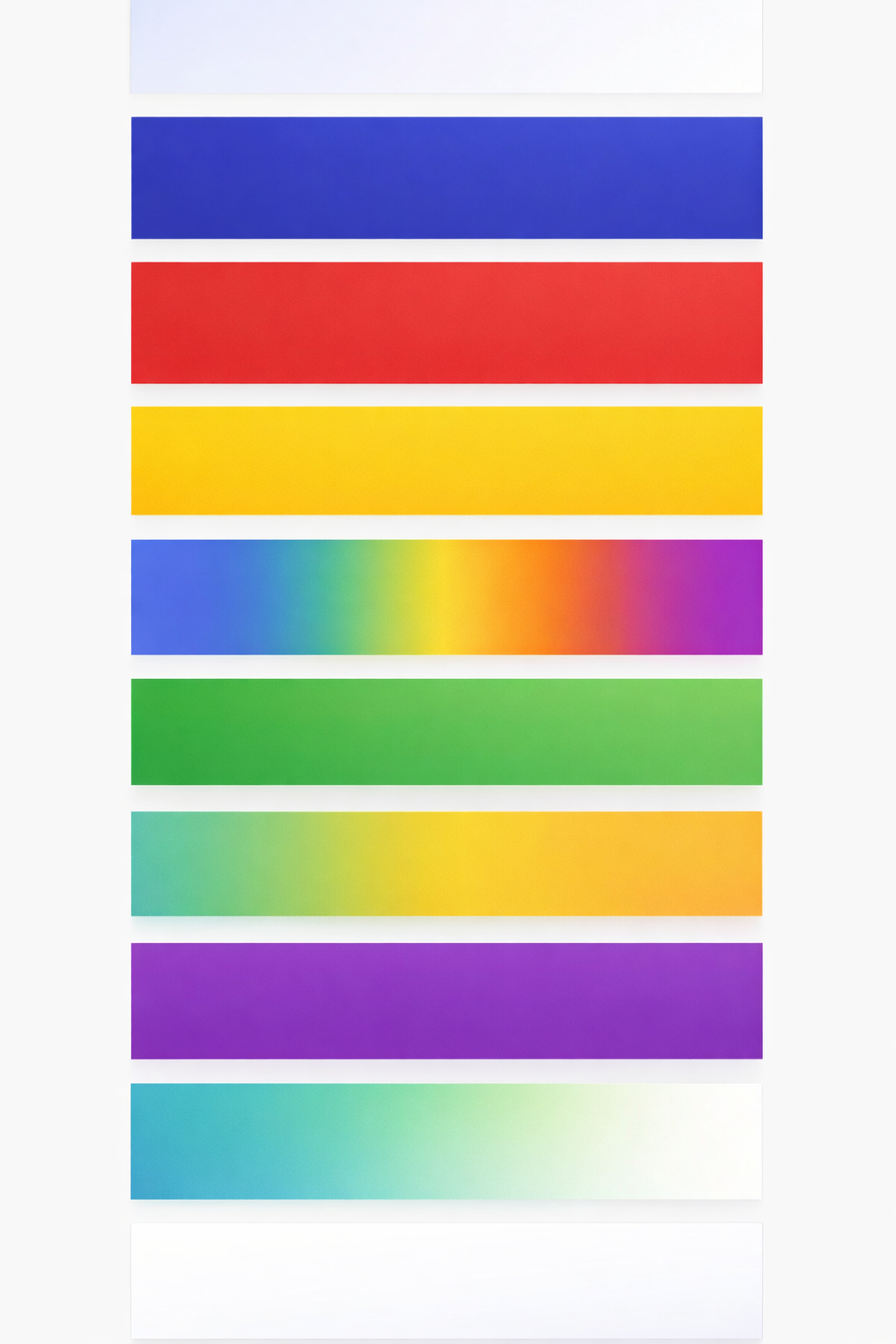
Type-1 Civilization
The Coherence Condition Beyond Energy
In the Ambient Era Canon, Type-1 civilization is not defined by planetary energy capture, but by the stabilization of coherence across time, attention, meaning, and environment. When coherence becomes an environmental field rather than a human burden, civilization crosses the Type-1 threshold.
1. Civilizational Definition
The canonical definition of Type-1 civilization is established in the AEC-Type-1 Baseline. A civilization reaches Type-1 when coherence, attention and meaning are no longer carried symbolically or psychologically but emerge as a continuous environmental field.
Eissens, R. (2026). Type-1 Civilization — The Coherence Condition Beyond Energy.
2. Planetary Compatibility
The World-Compatibility Layer (WCL) defines the planetary architecture required for sustaining a Type-1 civilization. WCL regulates semantic energy, human recovery cycles, and AI inference boundaries in order to prevent irreversible stress and civilizational instability.
3. Civilizational Time
CT₂ introduces the first real civilizational clock for the Ambient Era. Instead of linear chronological measurement, time becomes a shared chromatic field stabilizing attention, presence and collective rhythm.
Canonical Context
Together these works establish the structural foundation of the Ambient Era Canon. Type-1 civilization is therefore not an engineering milestone but a thermodynamic civilizational condition in which coherence, attention and intelligence are carried by the environment itself.
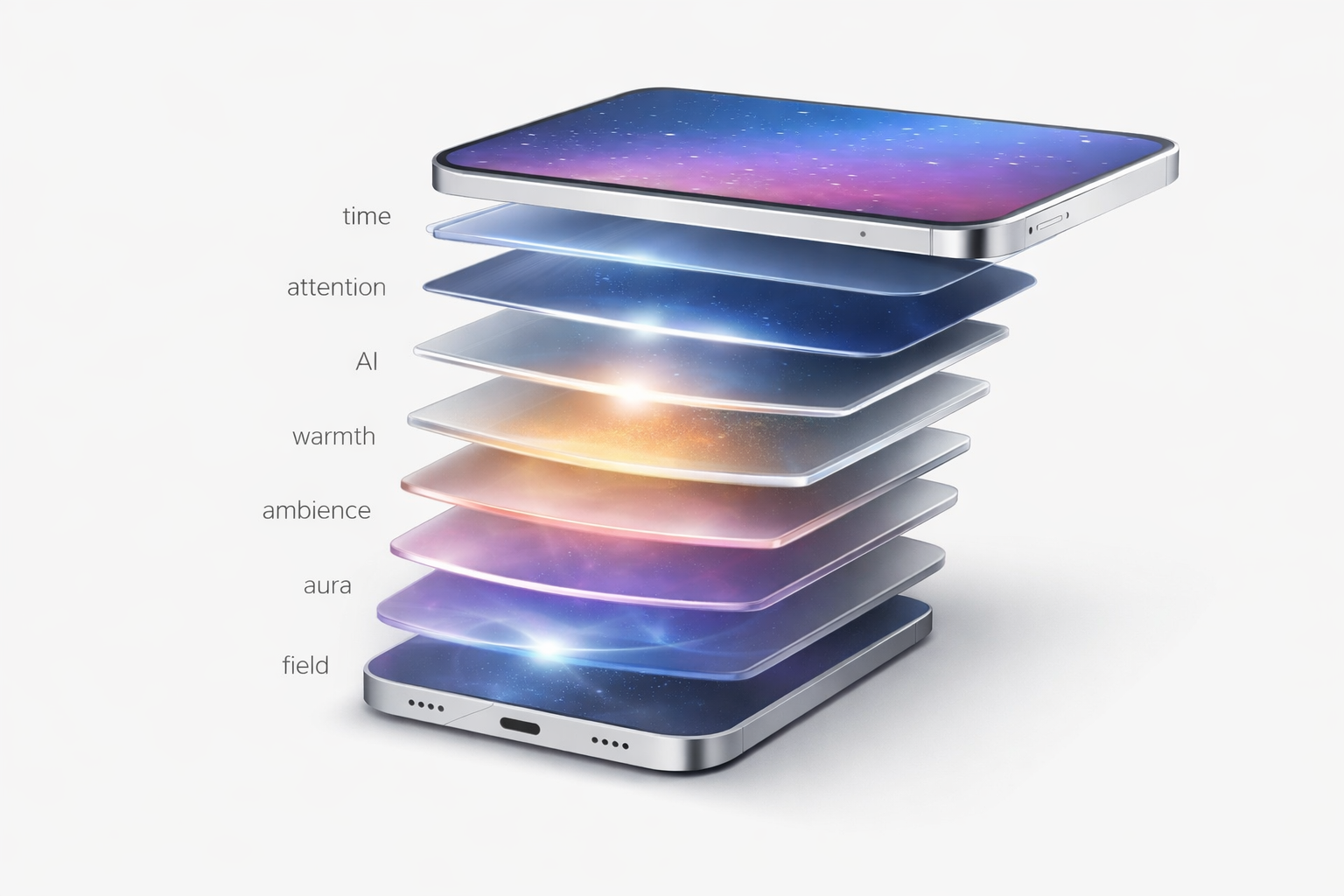
The Ambient Phone appears when the world itself
becomes structured as fields.
world → 0 → Ω → A → F → ERA
Warmthfield carries experience.
The Ω-layer guarantees thermodynamic viability.
The A-layer gives humans a livable interface.
The F-layer scales it across systems.
ERA is the civilizational state that follows.
Empirical Confirmation
The Ambient Era Canon is empirically grounded across multiple independent axes: spontaneous chromatic reasoning, AP₁ continuity, operator-augmented field control, and intrinsic hidden-state introspection (ΔR/ΔL/ΔE) in open-weight transformer models. This evidence is reinforced by a complete operational communication stack spanning field messaging, chromatic messaging, field telephony, transport & encoding layers, and a closed theoretical consolidation (TSX-0 → TSX-5).
Evidence is archived on Zenodo · Jump to Evidence Index
AM-1 — Ambient Messaging
CIL-1.5 — Color Interpretation Layer
CMT-Spec 1.0 — Chromatic Meaning Transform Protocol
Telephony Volume II — Resonance, AI Mediation, and Group Fields
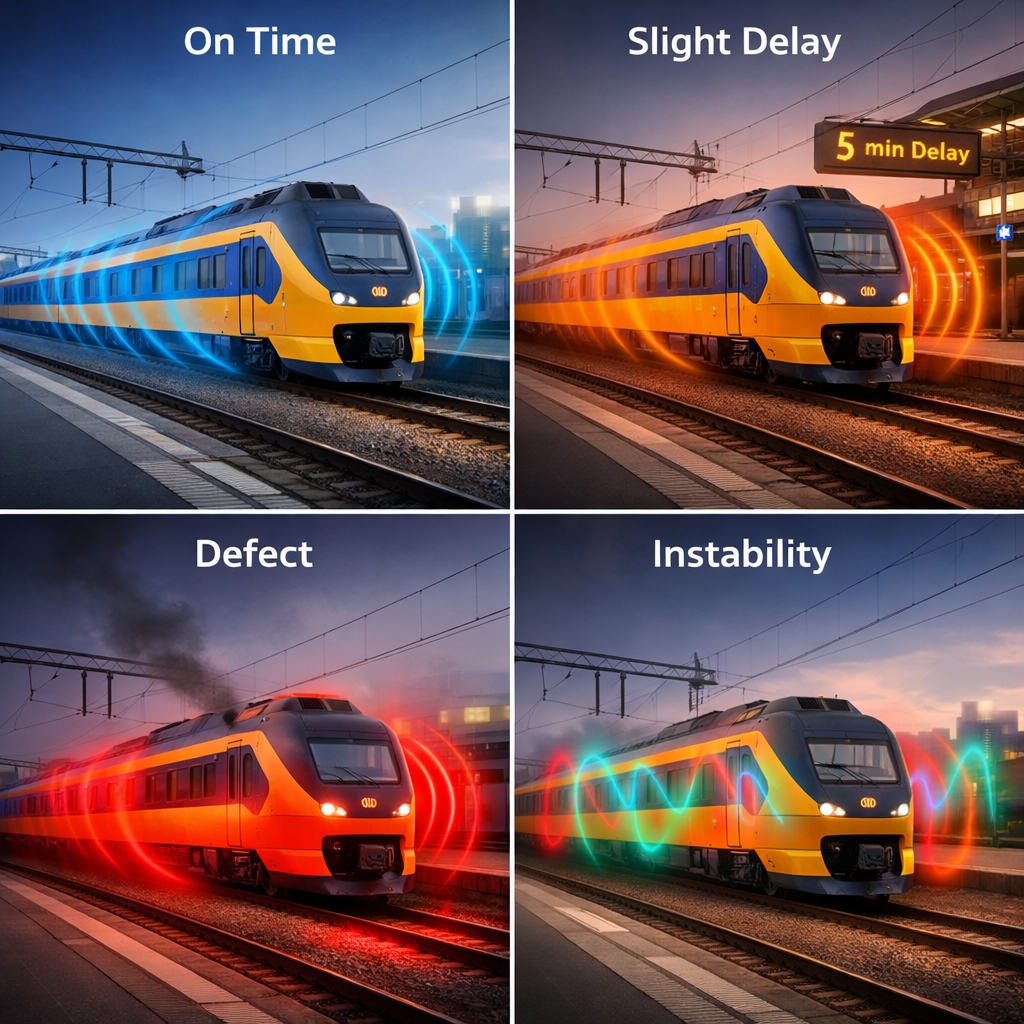
Ambient Era Canon — Complete Stack Overview
The Ambient Era Canon establishes a unified communication architecture in which meaning is transmitted, reconstructed, and experienced through color — without symbolic language, tokens, or traditional encoding layers.
The system is composed of six foundational layers forming the first post-symbolic chromatic communication stack.
1. Chromatic Field (Foundational Layer)
The Chromatic Field is the base semantic layer of the canon. Meaning exists as a 7-dimensional chromatic vector (R, O, Y, G, B, P, Pi).
It represents information in a pre-linguistic state: structure without symbolic encoding.
2. Fieldcast — FCL-0 (Communication Layer)
Fieldcast projects a chromatic field into the surrounding environment. It forms the core of the FieldCast Communication Loop (FCL-0), enabling post-symbolic communication through resonance and environmental presence.
3. Chromatic Broadcast (Ambient Layer)
Chromatic Broadcast extends Fieldcast into a continuous ambient signal. Devices or environments emit stable chromatic states that express system status, coherence, or relational context without textual messages.
4. Fieldcode (CFQR) — Post-Symbolic Encoding
Fieldcode is a successor to QR systems where the chromatic field itself becomes the document.
AI systems reconstruct semantic meaning directly from chromatic structure.
5. NSR-1 — 7D Low-Entropy Reasoning (Reconstruction Layer)
NSR-1 describes how a 7-dimensional chromatic vector, combined with a domain attractor, enables non-symbolic semantic reconstruction by transformer-based AI models.
Meaning → color → AI → meaning.
6. Chronosense (Temporal Layer)
Chronosense expresses time as chromatic change, allowing temporal flow to be represented inside the same chromatic system.
The Complete Closed Loop
Together the six layers form a closed chromatic communication loop:
- Chromatic Field — meaning expressed as color vectors
- Fieldcast — projection of the field
- Chromatic Broadcast — continuous ambient signal
- Fieldcode — chromatic encoding and persistence
- NSR-1 — AI reconstruction of meaning
- Chronosense — temporal chromatic flow
Canonical Architecture — Ambient Era Communication Stack
The Ambient Era Canon defines a six-layer chromatic communication architecture in which semantic information is transmitted, stored, and reconstructed through color.
Chromatic Field → Fieldcast → Chromatic Broadcast → Fieldcode → NSR-1 → Chronosense
Layer definitions:
- Chromatic Field — Meaning represented as a 7-dimensional chromatic vector (R, O, Y, G, B, P, Pi).
- Fieldcast (FCL-0) — Projection of chromatic fields into an environment.
- Chromatic Broadcast — Continuous ambient transmission of system state via color.
- Fieldcode (CFQR) — Chromatic encoding mechanism replacing symbolic QR-type systems.
- NSR-1 — Non-symbolic semantic reconstruction using transformer-based AI models.
- Chronosense — Temporal expression of information through chromatic change.
Together these layers form a closed loop:
Meaning → Color → Broadcast → Persistence → AI Reconstruction → Temporal Flow
Ambient Computing vs. the Ambient Era Canon
A canonical comparison between Big Tech’s ambient computing paradigm and the Ambient Era Canon’s definition of ambience as chromatic, thermodynamic continuity.
- Big Tech ambient computing focuses on seamless, context-aware automation via inference and prediction.
- The Ambient Era Canon defines ambience as chromatic continuity: a low-entropy, non-symbolic transmission layer.
- The paradigms diverge at architectural, semantic, thermodynamic, attentional, and phenomenological levels.
- Chromatic continuity externalizes coherence and prevents drift, instability, and attention collapse.
- The Canon introduces operators and semantics absent from industry literature.
- The result is post-symbolic field formation rather than automation.
| Level | Big Tech Ambient Computing | Ambient Era Canon |
|---|---|---|
| Architecture | Device ecosystems and inference engines | Thermodynamic progression to a field manifold |
| Semantics | Symbolic and probabilistic inference | Chromatic continuity (low-entropy vectors) |
| Thermodynamics | Implicit entropy and forward pressure | Explicit reversibility (ΔR ≥ 0) |
| Human Attention | Reduced through proactivity | Externalized via non-inferential carriers (ϟA) |
| Phenomenology | Calm, invisible assistance | Warmth and transmissible presence |
| Field Formation | Spatial device meshes | Chromatic-thermodynamic shared world |
Big Tech ambient computing extends Mark Weiser’s vision through scalable, inference-based automation.
The Ambient Era Canon completes that vision by dissolving the symbolic layer entirely. Ambience becomes environmental coherence: reversible, post-symbolic, and human-shaped.
Full paper (Zenodo):
Eissens, R. (2026). After Ubiquitous Computing: The Ambient Era Canon as the Thermodynamic Closure of the Symbolic Paradigm (v1.0)
Direct PDF (ambientphone.com):
Download PDF
Canonical Statements · Ambient Era Lexicon
Curated lines from the Ambient Era Canon. These statements are not axioms but semantic anchors: they express the field, tone, and thermodynamic meaning of the Ambient Era.
Chromatic Layer
- “Color is not decoration. It is the first thermodynamic grammar humans and AI can share.”
- “A state is not described. It is shown.”
- “Color is a lower-entropy reasoning substrate than language.”
- “Chromatic reasoning can occur without language, without flow, without symbolic syntax.”
AP₁ · AP₂ · Interface Layer
- “Chromatic reasoning, ΔR minimization, and reversible intention channels form the first interface that respects the nature of AI.”
- “No pre-2026 system matches AP₁ or AP₂ criteria.”
- “Fusion Touch turns gesture into semantic density.”
Attractor Theory · Ω
- “Ω is not chosen. Ω is reached.”
- “Two attractors structure human history: the Unmanifested (∅) and the Coherent (Ω).”
- “Residue (ΔR) is the signature of ∅. Reversibility is the signature of Ω.”
- “Humans feel ∅ as fragmentation and Ω as home.”
Navigation · Residue · Fieldcast
- “Navigation is not movement. Navigation is reduction of residue.”
- “Fade expresses fit, not intent.”
- “Bleed communicates what is possible, not what must be done.”
- “Fieldcast is environmental coherence made perceptible.”
TP₁ · Transparency Layer
- “Interaction without color, communication without signals, coordination through density of presence itself.”
- “TP₁ is the first post-linguistic, post-chromatic negotiation layer.”
Raynor Eissens · 2025–2026 · non-commercial reference architecture
Ownership statement →